Exposition Art Blog: graphic
Showing posts with label graphic. Show all posts

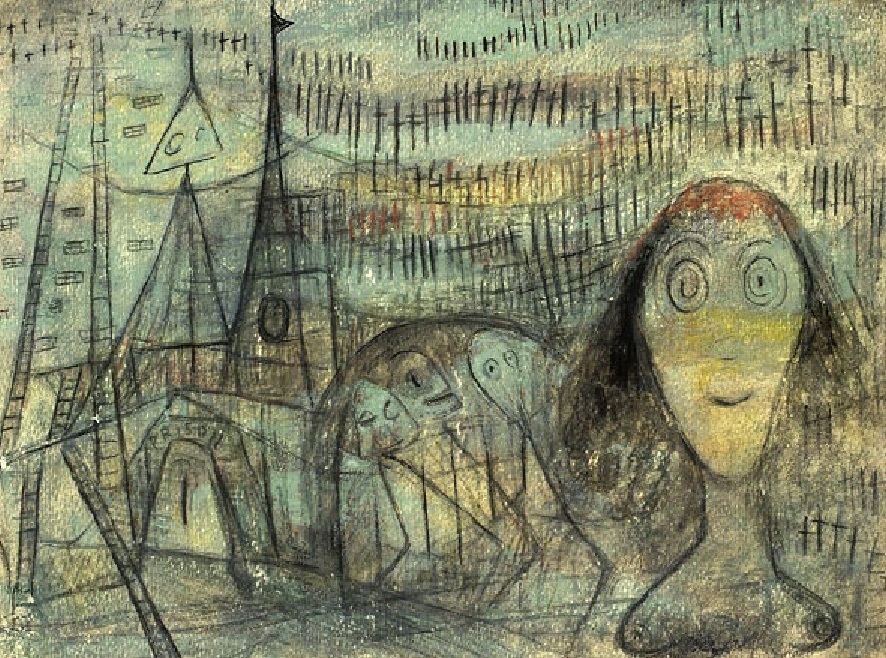
Alen Divis


 Alen Divis ( 1900 – 1956) was a Czech painter known for his melancholic art. Having spent much of his life abroad, often working in solitude, he remained rather unknown during his life but has had a postmortem revival in the art world.
In 1947, after the end of the Second War and the liberation of Czechoslovakia, Diviš returned to his native country, more than two decades after he had first left for Paris. Upon his return, he achieved a brief period of success. His written memoirs of Santé were published in a weekly paper, and in February 1948, his recent work was exhibited in Prague. The same month, however, brought the Communist coup d'état which would marginalize artists of his type out of work. He spent the rest of the decade producing illustrations for Karel Jaromír Erben's mid-19th century collection of ballads
"He became a sort of mythological figure in Czech modern art. He was known as an artist that was forgotten and then sort of miraculously rediscovered. He was someone who was very secretive, whose art was very dark. He was more a figure coming from a romantic literature than from life..."


Bruno Canova "The Art of War"


 Bruno Canova was born in Bologna in 1925, was drafted in 1943 to military service in the Navy and shortly after he was arrested for attempting to organize a partisan group in La Spezia and interned in a labor camp in the Sudetenland German Brüx .After the liberation, he studied graphic design in the Boarding Schools of the “Convitti della Rinascita”, in Rome and Milan. Among his teachers: Luigi Veronesi, Max Huber, Albe Steiner, Lucio Lombardo Radice, Gabriele Mucchi. After his debut in 1949 in Prague, in an exhibition of Italian graphics and after having been, for some years, the political cartoonist of “L’Unità”, he devoted himself only to his work as an artist in Rome, the city where he would spend all his life and where he frequented, among others, Mario Mafai, Alberto Ziveri, Renato Guttuso, Renzo Vespignani, Salvatore Scarpitta, Ugo Attardi, Pier Paolo Pasolini. In 1965 he won the Premio Suzzara and participated in the Quadrennial of Rome, where his work was noticed by Carlo Ludovico Ragghianti, who wrote him a letter of great appreciation. In this period he develops a research on the city and its suburbs, and composes spreadsheets and drawings in black and white with a few chromatic elements in an assembly close to the experiences of historical avant-gardes. Draftsman and engraver of great quality, in the early eighties his path opens onto color and to a painting where the memory of the Roman School merges his analytical vision with the suggestions of the Northern Renaissance in a search which lasted until the last day. Marked as he was by his dramatic war experiences, from 1966 Bruno Canova worked continuously in the exhibition "The Art of War" that was exposed in public spaces in many Italian cities, with works where drawing and painting merge documents, newspapers and vintage posters, on the wake of the Dadaist collage and the outcomes are often close to certain conceptual experiences. Among his many exhibitions, we must remember his solo shows at the Villa Pignatelli in Naples (1975), at the Palazzo dei Diamanti in Ferrara (1976), at the National Central Library of Rome (1993) and in the Museum of Roman Laboratory of the University "La Sapienza" (1998 ), at the Quadrennial in Rome in 1965 and 1986, and the participation in the Italian Pavilion, section Lazio, 54th Venice Biennale at the Palazzo Venezia in Rome. He died in Lacco Ameno ( Ischia ) July 31, 2012.(.wikiart.org)


Marek Oberlander - Polish Painting & Culture


Born 1922 in Szczerzec near Lvov, died 1978 in Nice, France.
Oberländer - along with Jan Dziedziora, Jacek Sienicki, and Elżbieta Grabska - was an initiator and among the most active organizers of the "Against War, Against Fascism" Polish National Exhibition of Young Visual Arts, held in July of 1955 at Warsaw's Arsenal just before the political "thaw" of 1956. The idea for the exhibition was first put forward at a social gathering held at his small apartment in the Okolnik district of Warsaw. Stalin had died two years earlier and hopes were high for ideological change. It was in this atmosphere that a group of young painters, supported by an equally young art historian and critic, decided to organize an exhibition made up of works created during outside of the official art world during the Socialist Realist period and subsequently hidden away in private studios for years. Once assembled, the exhibition was viewed as a protest against both Socialist Realism and Colorism - a movement that had ruled Polish art after World War II, reigning especially strong in academic circles (.....) Throughout this time he was also painting and drawing, creating numerous works in which he gradually cast off his original brutality and focused on creating a more intimate mood. These were largely portraits that emphasized the psyche of his models, though he also painted genre scenes and still lifes and at times turned towards abstraction. In general, his works of this period were more variegated than previously. With time he began to deform the human figure more and more radically, though he retained it as a clear symbol of individual experience (evident in his ink and gouache portraits of 1957-58, among them, the Garbate / Hunchbacks series). Through constant modification of the human silhouette, he consistently and (what is more important) successfully strived towards a maximal synthesis of form. He drew inspiration from the world of nature; the unreal, sometimes stylized, elongated shapes of insects became a model for his approximately drawn, over-simplified, highly condensed, vertically oriented female figures (Sylwetki / Silhouettes, 1961-63). The vibrating, unsettled components of these compositions (a spider web-like tangle of thin lines, unrestrained splashes and drippings of semi-translucent paint) strengthened their disquieting, angst-ridden aura. Oberländer's "torsos" and "skeletons" were often compared to Jan Lebenstein's Figury hieratyczne / Hieratic Figures and Figury osiowe / Axial Figures, though this seems somewhat unjustified. Lebenstein's compositions seem more ostentatiously and tangibly aggressive, while the drama in Oberländer's figures derives from their hidden, inner life. In spite of this, the works of both artists evoke associations with Wols's Tachiste drawings of seemingly anatomical assemblages.(Author: Małgorzata Kitowska-Łysiak, Art History Institute of the Catholic University of Lublin, Faculty of Art Theory and the History of Artistic Doctrines, December 2001. culture.p )


Jan Koblasa - Czech sculptor, artist and poet


Jan KOBLASA (1932-2017)  Czech poet, graphic, painter, scenographer, sculptor, writer, university educator and artist .
"Jan Koblasa was born on October 5th 1932 in Tabor. Koblasa is one of the leading figures in European sculpture second the 20th century. His expressive symbolic, avant-garde work is oriented development studies at the Prague Academy of Fine Arts (1952-1958). With several young protesters then initiates establishment of the "Klub" (from 1957 group Spidrové), reacting to recessions neodadaistickou zmrtvělost and absurdity of the time. Impressed concrete music, expressionism, and existential philosophy tries to even the statues paintings express my sense of life. Becomes the leader of the younger generation and one of the prominent nekonformního, radically oriented art. Attend the first informal, then Czechoslovak prestigious exhibitions of modern art at home and abroad. The occupation of Czechoslovakia in August 1968, it captures in Italy. Coming back. Gaining asylum in northern Germany. In 1969, based in Kiel at the Fachhochschule Study Muthesius free sculpture, which the professor leading up to 1998. He lives in Hamburg, where his work is well received and respected. The specific form of expressive, content-rich expression, which first went through phases of radical abstraction, holds unconventional views of man and his destiny. Contributes to the emphasis on a mythical archetype of cinematography, in which the message is Koblasa analogy to the current life experience. Until now prepared - mostly in Europe - about a hundred solo exhibitions. In his work has won numerous awards and his works own the world's major collections. Representative of the artist's monograph published in Czech and German."(galerieubetlemskekaple.cz)