Exposition Art Blog

Isaac Witkin - New Generation of sculptors - Abstract Sculptures


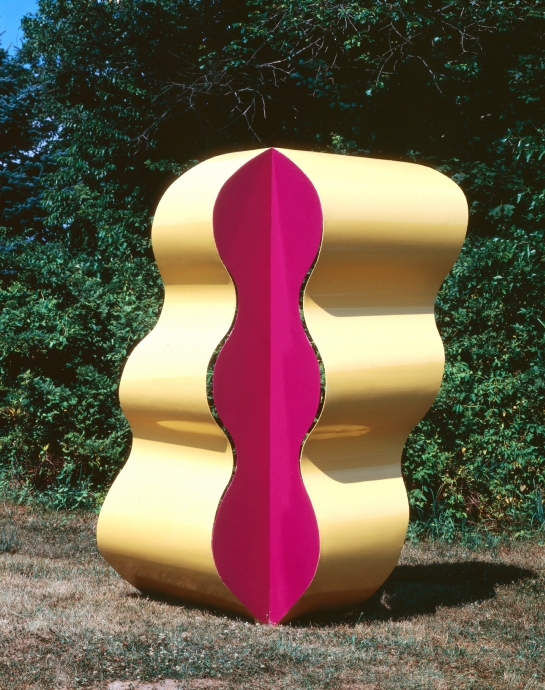
Isaac Witkin internationally renowned modern sculptor, was born in Johannesburg, South Africa on 10 May 1936, and he died 23 April 2006. Witkin entered Saint Martin's School of Art in London in 1957. Studying under Sir Anthony Caro and alongside other luminaries in training such as Phillip King, William G. Tucker, David Annesley and Michael Bolus, Witkin learned and helped create a new style of sculpture that led to their being called the New Generation of sculptors when their innovating abstract forms of modern sculpture reached and changed the art world. Witkin's work, abstract works of usually brightly colored fiberglass or wood, in particular was noted for its "witty, Pop-Art look".
"Isaac Witkin rejected the idea that the human figure is necessary to sculpture, and instead explored abstraction in his work. The sculpture consists of welded steel plates painted bright orange. Each plate has an irregular geometric shape, some straight and rigid and others elegantly curved. The sheets slice into one another, delicately balancing on precise contact points. Their sharp edges pierce the space around them, as if Witkin is not only carving the sculpture but also carving air. The overlapped and stacked forms allow for a constantly changing play of light and shadow, assuming different configurations based on the viewing angle. Witkin had a consistent interest in how the scale of a sculpture can be determined by its relationship to the human body. He once stated that “I aim to establish a freedom to move in multiaxial space in a way that draws the spectator in and around the sculpture to experience different aspects of an evolving dynamic.”




https://milenaolesinska.blogspot.com/p/blog-page_50.html

Milena Olesinska


Surrealism - oil painting on canvas 70cm x 50cm 


https://milenaolesinska.blogspot.com/p/blog-page_50.html

Fateh Moudarres


Fateh al-Moudarres (1922–1999) was a Syrian painter and one of the leaders of the modern art movement in Syria. Moudarres studied at the Accademia di Belle Arti in Rome, where he was influenced by Surrealism. After he completed his studies, he returned to Syria where he grew and honed his skills under the auspices of long-time friend, mentor, and tutor Wahbi Al-Hariri.
Growing up Fateh Moudarres spent much time in the countryside, but the agricultural crisis of the 1960s forced him to relocate to Damascus. The city at that time was experiencing a period of unprecedented growth and fast becoming an increasingly cramped and hostile environment in which to live. These conditions were compounded by the political and social unrest sweeping the Arab World. Against this backdrop Moudarres, along with several his artist contemporaries, often sought to depict the everyday people and the problems they encountered. He was especially moved by the life of ordinary people in the Syrian countryside. For them, what on the surface which can often incorrectly be characterized as an idyllic existence was in fact a way of life marred by problems caused by social upheavals. The present composition depicts the life of the simple peasants, showing the country bride and wedding party. In such a scene one might expect to see joyful celebration, but instead there is a palpable aura of sadness, as Moudarres reveals something of his feelings about suffering and helplessness of these women in the rural areas.Wikipedia 


https://milenaolesinska.blogspot.com/p/blog-page_50.html

Emily Mason - Lyrical Abstraction


Emily Mason (1932 – 2019) was an American abstract painter and printmaker. Mason developed her individual approach to the Abstract Expressionist and color field painting traditions with her veils of color and spontaneous gestural mark. Mason was born and raised in New York City, where she lived and worked until her death.
Mason's career began to flourish in the 1960s. She was awarded her first solo exhibition in 1960 at the Area Gallery in New York City. In the intervening years, she has had many solo exhibitions in New York and around the country and is currently represented by Miles McEnery Gallery in New York and LewAllen Galleries in Santa Fe.
In The Brooklyn Rail, publisher Phong Bui describes Mason's position between abstract expressionism and color field painting, noting: "She was interested in neither the former's existential angst nor the latter's use of absorbed color pigments on raw canvas (she paints on primed canvases). By allowing painterly gestures to coexist with thin, poured layers in a wide range of colors in all manner of hues and saturations, Mason is able to amplify her colors—which are infused with forms that derive from both memory and free association with concrete surroundings in nature—while embracing their complex tonalities."Wikipedia


Pasquale Russo Maresca


Pasquale Russo Maresca (1968 –2020) was an Italian painter best known for his work and research focusing on anatomy, especially the composition of the human face. Maresca sought to explore the anatomical features of the face within his paintings by reconstructing the face and inserting illusion into it. He called this technique "Sette settimi di volto". He divided his professional time between Italy, Mexico and Slovakia.Maresca was born in Milan, Italy, on July 20, 1968.Maresca became known for his religious work in the 1990s and 2000s. In 1995, Maresca was commissioned to create a depiction of the crucifixion of Andrew the Apostle for Sant'Andrea church in Pioltello. He then painted the crucifixion of Christ for the same church in 1996. In 1997, Maresca was commissioned to paint the altar scene, as well as fresco of the dome for a cemetery in Trezzo sull'Adda. In 2000, he completed a painting of the Visitation for the church in Locate Varesino. He held a solo show showcasing his paintings of the human face at the Montrasio gallery in Milan in 2004.Wikipedia