Exposition Art Blog

Russian avant-garde art Pavel Filonov

Pavel Filonov was a prominent Russian art theorist, painter, and poet. He began art lessons in St. Petersburg at around fourteen years of age, and in 1908, at around age 25, entered the St. Petersburg Academy of Arts. After his expulsion from the Academy in 1910, he joined the Russian art group Soyuz Molodyozhi, and was a contributor to the group’s magazine. In 1912, he published an essay The Canon and the Law in which he expounded his ideas on analytical realism, also known as “Universal Flowering,” which refuted the surface geometry of cubism. Filonov’s artistic philosophy revolved around the desire to reveal the inner soul of the objects in the painting, a belief system he remained devoted to his entire life. Later in his artistic career he was also close to Russian futurist painters Vladimir Mayakovsky and Velimir Khlebnikov.


 Upon the beginning of World War I, Filonov enlisted and served on the Romanian front. Perhaps his experiences in the war led him to also be an active member in the Russian Revolution of 1917, serving as Chairman of the Revolutionary War Committee of Dunay Region. His first exhibition was in 1919, after the tumult of the war and revolution, and beginning in 1923 served as a professor at the St. Petersburg Academy of Fine Arts, the same academy from which he had been expelled thirteen years earlier.


 During his career he organized the large art school of Master of Analytical Realism, which eventually had up to seventy members. Staying true to his artistic theory, Filonov rarely made money from his paintings, as he refused to sell them to individual patrons. His desire was to give them all to the Russian Museum as a gift, so they could start a Museum of Analytical Realism. His economic hardships worsened, however, due to the strict Soviet restrictions on artists and their exhibitions, and he starved to death in 1941, during the Nazi Siege of Leningrad.
For a time after his death, it was forbidden to exhibit any of Filonov’s works, which would have made them easy to steal. There was a legend, however, that his paintings were protected by the ghost of Filonov, and anyone trying to steal them would die, become paralyzed, or suffer a terrible misfortune. Filonov’s desire to gift his works to the Russian Museum was finally realized after his death, when many of his works, which had been saved by his sister, were given to the museum.(Wiki Art )


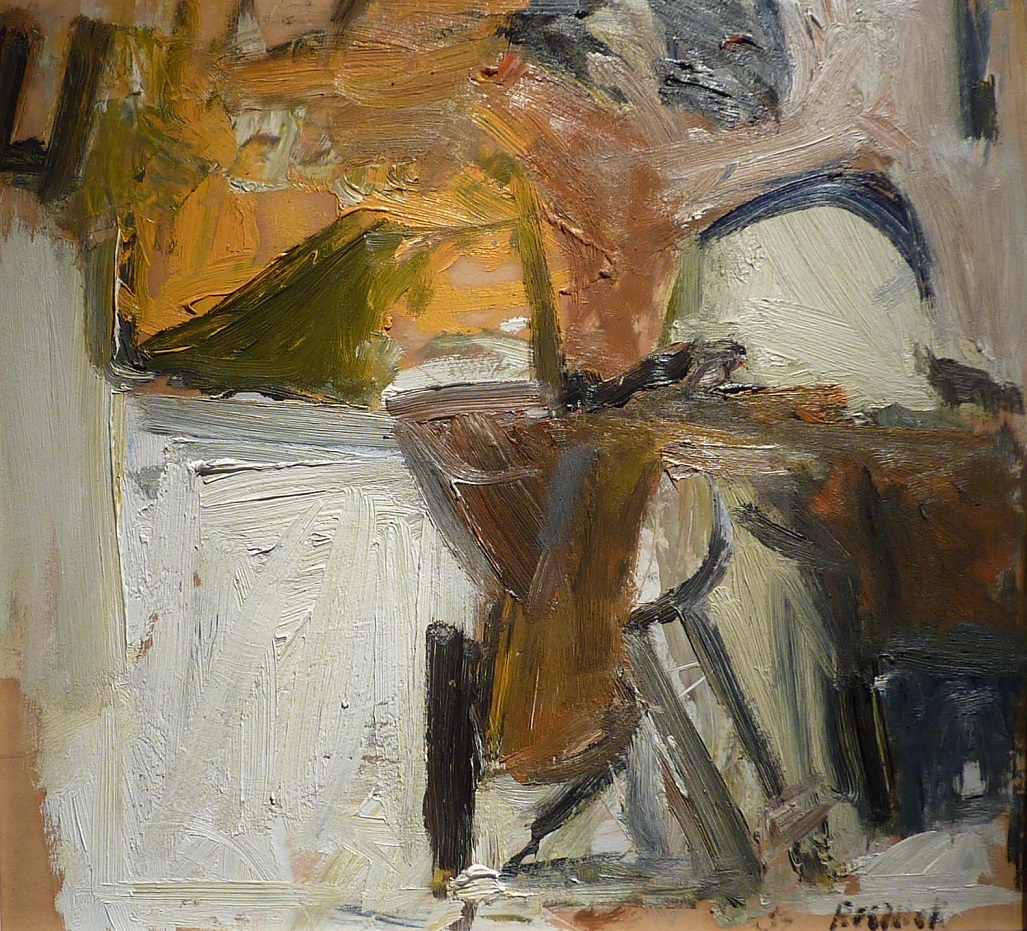
Fred Cress

Frederick Harold "Fred" Cress AM (10 July 1938 – 14 October 2009)was a British painter who migrated to Australia and won the Archibald Prize in 1988 with a portrait of John Beard.
Cress was born in Poona, British Raj, but went to England with his parents in 1948, when he was ten. He was educated at the Birmingham College of Art in England, and migrated to Australia in 1962 as a "ten pound Pom", meaning that he only had to pay ten pound for his fare to Australia.Cress met the painter Anne Judell and married her in 1967, they divorced in 1991. He started his career painting figuratively, but became well known for his abstract work in the late 60s and 70s. He returned to figurative painting in the late 80s after he won the Archibald Prize with a portrait of his friend and colleague, John Beard. He was made a Member of the Order of Australia in 2003 for services to visual arts.


 In 1990 Cress bought a 17th-century stone farmhouse in Southern Burgundy, France. He spent the next 20 years of his life living half the year in France and half the year in Sydney with his partner, the photographer, Victoria Fernandez. Many of Cress's later works have visual references to his time spent in France.
Cress was diagnosed with prostate cancer in January 2003. In 2009 he declined to continue with treatment while he worked on his last exhibition, entitled 'End Game One', held in Australian Galleries, Paddington. He died on 14 October 2009.Wikipedia


New paintings Milena Olesinska


  Oil painting 100cm x 70cm

  Oil painting 100cm x 70cm

Richard Lindner

Richard Lindner (November 11, 1901 - April 16, 1978) was a German-American painter.
Richard Lindner was born in Hamburg, Germany. His mother Mina Lindner was American and born in New York as daughter of German parents.
In 1905 the family moved to Nuremberg, where Lindner's mother was owner of a custom-fitting corset business and Richard Lindner grew up and studied at the Kunstgewerbeschule (Arts and Crafts School since 1940 Academy of Fine Arts). From 1924 to 1927 he lived in Munich and studied there from 1925 at the Kunstakademie. 


In 1927 Lindner moved to Berlin and stayed there until 1928, when he returned to Munich to become art director of a publishing firm. He remained in Munich until 1933, when he was forced to flee to Paris. Once in Paris, Lindner became politically engaged, sought contact with French artists and earned his living as a commercial artist. He was interned when World War II broke out in 1939 and later served in the French Army.
In 1941, Lindner moved to the United States and worked in New York City as an illustrator of books and magazines. There he made contact with New York artists and German emigrants such as Albert Einstein, Marlene Dietrich, and Saul Steinberg. In 1948, Lindner became an American citizen.


"The artistic universe of Richard Lindner is unique: he is highly genuine, he is full of urban energy, and he is driven by weird eroticism...Richard Lindner started his career as an artist eventually at the age of 40 in New York. In this metropolitain jungle Lindner created his oeuvre: exciting and powerful images of robot like figures, amazons and heroines, harlequins of self-styled heroes - his artistic panorama of the unruly 60s and 70s of the 20th century" (sic) (Claus Clement quoted in: Richard Lindner - Paintings, Works on Paper, Graphic - Nuremberg 2001). One of Lindner's paintings, "Boy With Machine," 1954, appears on the cover-leaf of Deleuze's Anti-Oedipus, and thus the image has formed part of many readers' introduction to Deleuze's later and more accessible philosophy.Wikipedia


Milton Resnick

Milton Resnick (1917-2004) was an American artist noted for abstract paintings that coupled scale with density of incident. It was not uncommon for some of the largest paintings to weigh in excess three hundred pounds, almost all of it pigment. He had a long and varied career, lasting about sixty-five years. He produced at least eight hundred canvases and eight thousand works on paper and board.
He also wrote poetry on a nearly daily basis for the last thirty years of his life. He was an inveterate reader, riveting speaker and gifted teller of tales, capable of conversing with college audiences in sessions that might last three hours.
During his lifetime he was represented by the following galleries: Poindexter Gallery, Howard Wise Gallery, Max Hutchinson, and Robert Miller


 Paintings held in public collections include: New Bride, 1963 Smithsonian American Art Museum, Washington, D.C., Mound, 1961 National Gallery of Art, Washington, D.C., Saturn, 1976 National Gallery of Canada, Ottawa, Ontario], Elephant, 1977 Milton Resnick and Pat Passlof Foundation, New York, Earth, 1976 Museum of Modern Art, NYC, Wedding, 1962 The Metropolitan Museum of Art, New York, Pink Fire, 1971 National Gallery of Australia, Canberra, and Untitled, 1982 Whitney Museum of American Art, New York, along with many pictures of comparable quality in smaller collections — public and private — make for some, an effective case for Resnick as an exponent of the sublime.Wikipedia


Abstract Expressionism Mary Abbott

Mary Abbott (born July 27, 1921) is an American artist known as a member of the New York School of abstract expressionists in the late 1940s and 50s. Her abstract and figurative work were also influenced by her time spent in St. Croix and Haiti, where she lived off and on throughout the 1950s.( Wikipedia )


Among the early exponents of Abstract Expressionism, Mary Abbott creates powerful oil paintings in which she combines spontaneous, gestural brushwork with a highly creative use of color. Lauded for its energy and vital feeling of immediacy, her work reflects her desire to translate sensations into paint; as she puts it, “I like the process of painting. The intensity of Living Nature through myself––using the medium, paint, color and line defining the poetry of living space; that is my aim, life and work.”


Born in New York on 27 July 1921, Mary Abbott boasts an impressive pedigree: a descendent of such luminaries as President John Adams and General Robert E. Lee, she is the daughter of Naval Commander and military adviser Henry Abbott and his wife, Elizabeth Grinnell, a poet and writer. Abbott grew up primarily in Manhattan, where she attended Miss Chapin’s School, graduating in 1939. She also spent time in Washington, D.C., Concord, Massachusetts and Southampton, Long Island. At the age of twelve she enrolled in Saturday classes at the Art Students League of New York; by the late 1930s, she was taking advanced courses there, working under the painter George Grosz, who was impressed by her serious demeanor. Throughout this period, she also became acquainted with the work of master painters, ranging from Cimabue and Tintoretto to Eugene Delacroix, Paul Cézanne, Henri Matisse, all of whom came to influence her art. On her summer trips to the nation’s capital, Abbott also studied with Eugene Weiss at the Corcoran Museum School.( spanierman modern )


Alice Bailly

Alice Bailly was one of Switzerland’s most radical painters in the early decades of the 20th century. By 1906, Bailly had settled in Paris, where she became friends with many avant-garde modernist painters, including Juan Gris, Francis Picabia, and Marie Laurencin.
While she was exhibiting her early wood engravings in Paris, Fauvism came to the fore. Bailly was inspired by the style’s bold use of intense colors, dark outlines, and emphatically unrealistic anatomy and space. In 1908, her new paintings hung at the Salon d’Automne alongside the art of the principal Fauve painters.


 Continuing her stylistic experimentation, Bailly developed her own variation of Cubism. In 1912, her work was chosen to represent Switzerland in a traveling exhibition seen in Russia, England, and Spain. When World War I broke out, Bailly returned to Switzerland, where she invented “wool paintings,” mixed-media works in which short strands of colored yarn imitated brush strokes.


Bailly was briefly active in the Dada phenomenon. She moved to Lausanne in 1923 and stayed there the rest of her life, continuing to exhibit regularly and promote the cause of modern art. In 1936, Bailly accepted a commission to paint eight large murals for the foyer of the Theatre of Lausanne. This monumental task led to exhaustion, which presumably made Bailly more susceptible to the tuberculosis that claimed her life two years later. (National Museum of Women in the Arts)


Russian avant-garde artist Natalia Goncharova

Natalia Goncharova was a major figure in early 20th century Russian art, and is now one of the most highly priced Russian artists in history. A controversial figure who scandalized Moscow with her open cohabitation with the modernist painter Mikhail Larionov, she was noted for her avant-garde art which borrowed heavily from Russian icon painting and other forms of primitive art. She left Russia in 1915, spending the rest of her career in Geneva and Paris, where she contributed stage designs to Sergei Diaghilev for his Ballets Russes. The great niece of Natalia Pushkina, wife of Alexander Pushkin, Goncharova's progress as an artist was influenced by her attraction to modern art (inspired by painters from the Ecole de Paris, and Der Blaue Reiter, as expressed in her own interpretations of Futurism, Cubo-Futurism), and also, rather confusingly, to traditional Russian folk art (inspired by Russian medieval painting and other traditional artifacts). At her major solo exhibition in 1913, her primitive-style Russian works were displayed side-by-side with her more modernist paintings. Although she died in poverty, her pictures now sell for multi-million dollar sums.


 Natalia (Natalya) Goncharova was born into a prosperous family in Nagaevo village, near Tula in provincial Russia. After leaving school she moved to Moscow to study sculpture at the Moscow School of Painting, Sculpture and Architecture (1898-1902), where she completed less than four years of study - instead of the normal ten years - and also met her life partner, the artist Mikhail Larionov. Having abandoned sculpture in favour of painting - she absorbed pastel drawing from Larionov, as well as watercolour painting and oils - Goncharova began exhibiting in Moscow in 1904. Two years later, she participated in Sergei Diaghilev's exhibition of Russian art in Paris.


 Between 1912 and 1914 Goncharova was involved in a number of avant-garde activities. In 1913, for example, she took part in theatrical performances alongside Vladimir Mayakovsky and even acted in a movie. Along with other members of the Russian futurist group, she also produced illustrations for experimental book publications. Like her fellow artists Kasimir Malevich (1878-1935), Lyubov Popova (1889-1924) and Vladimir Tatlin (1885-1953), she was aware of Cubism in Paris and introduced Cubist techniques into her work. This can be seen in the canvas entitled The Laundry (1912) in which Goncharova uses the multiple viewpoint of the Cubist still life while simultaneously introducing fragments of words to suggest the subject of the painting and to emphasize the flatness of the canvas. She was also familiar with Italian Futurism. Goncharova and her Russian colleagues referred to their work as "Cubofuturist", in order to distinguish it from its Parisian sources. A well-known example of her Futurist work is The Cyclist (1912-13). ( ENCYCLOPEDIA OF VISUAL ARTISTS )


Romantic artist Eugène Delacroix

Ferdinand Victor Eugène Delacroix( 26 April 1798 – 13 August 1863) was a French Romantic artist regarded from the outset of his career as the leader of the French Romantic school.
As a painter and muralist, Delacroix's use of expressive brushstrokes and his study of the optical effects of colour profoundly shaped the work of the Impressionists, while his passion for the exotic inspired the artists of the Symbolist movement. A fine lithographer, Delacroix illustrated various works of William Shakespeare, the Scottish writer Walter Scott and the German writer Johann Wolfgang von Goethe.


Ferdinand Victor Eugène Delacroix( 26 April 1798 – 13 August 1863) was a French Romantic artist regarded from the outset of his career as the leader of the French Romantic school.
As a painter and muralist, Delacroix's use of expressive brushstrokes and his study of the optical effects of colour profoundly shaped the work of the Impressionists, while his passion for the exotic inspired the artists of the Symbolist movement. A fine lithographer, Delacroix illustrated various works of William Shakespeare, the Scottish writer Walter Scott and the German writer Johann Wolfgang von Goethe.