Exposition Art Blog

Carel Nicolaas Visser


Carel Nicolaas Visser ( 1928 - 2015) was a Dutch sculptor. He is considered an important representative of Dutch abstract-minimalist constructivism in sculpture.From 1948 until 1949 Visser studied architecture at the Technical University in Delft and subsequently from 1949 until 1951 sculpture at the Royal Academy of Arts, The Hague. After study in England and France, he settled as an independent artist in 1952 in Amsterdam.
Carel Visser is seen as one of the most important constructivist sculptors of the Netherlands. His later work is characterized by the assembly of a variety of materials, such as tires, oil drums, car windows, leather, sheepskin, eggs and so on. He made organized connections, a kind of assemblages, with this so-called great and sometimes small objets trouvés (found objects). Some of his work has been compared to a musical composition in which repetition and variation play an important role.
Around 1960, Visser was focussed on massive closed cube of iron and "slack" cube wire. Visser, among other things, was inspired by nature (plants and animals) which also explains his use of natural materials such as wood, wool, sand, feathers, bones, rope and leather.His works from the period 1975-1985 could be called environments, as opposed to the more sculptural work as the dying horse (about 1949).Wikipedia


Portrait of a young woman


 Portrait of a young woman - drawing on paper - pastels


My website


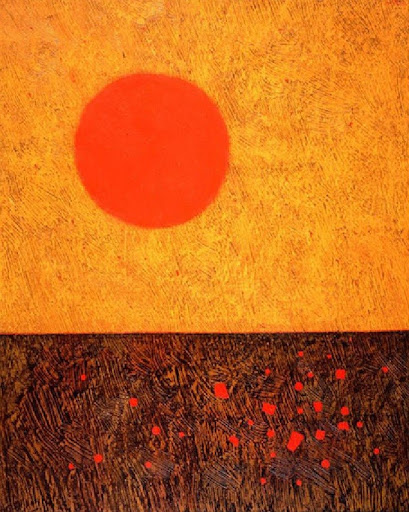
Mordecai Ardon


 Mordecai Ardon (1896 –1992) was an Israeli painter. Ardon was born Max Bronstein in 1896 in Tuchów, Galicia (then Austria-Hungary, now Poland). In 1933 he emigrated to Jerusalem in Mandate Palestine. He was granted Palestinian citizenship in 1936 and changed his name to Mordecai Ardon.
He participated in the Venice Biennale of 1968.Beginning in the 1950s Ardon adopted a complex system of symbolic images in his paintings, taken from the Jewish Mystical tradition (Kabbalah), from the Bible and from a tangible reality. In his painting "Gates of Light", for example, he expressed "the inner mystery and timelessness of the landscape." His work seeks to impart a cosmic dimension to the present, linking it to antiquity and mystery. The same approach can be found in "At the Gates of Jerusalem" (1967), which shows the attempt to "convey his feelings about the cosmic significance of Israel’s return to the Old City of Jerusalem during the Six-Day War". "Bird near a yellow wall" (1950) demonstrates his simplistic involvement with the Holocaust, a subject to which he was one of the few Israeli artists to devote a phase of his work, at that time.
As a teacher and director of the "New Bezalel", Ardon conveyed his sense of social involvement, his tendency towards Jewish mysticism and local mythology, and the combination of personal national symbols with reality-always stressing masterful technique../wikiart.org/


Juan Ponc - Surrealism


 Juan Ponç (1927 - 1984) was a Catalan artist and member of the avant-garde group Dau al Set.Joan Ponç was born in the Sarría neighborhood of Barcelona, Spain to Gumersindo Pons and Dolors Bonet.He attended the Colegio Salesiano San Antonio de Padua de Mataró boarding school from 1940-1942, during which time he decided to pursue an interest in painting. In 1946, Ponç presented his first solo art exhibition at the Sala Arte de Bilbao, and met fellow Dau al Set contributors Joan Brossa, J.V. Foix, and Arnau Puig. Over the next couple of years, Ponç actively interacted and collaborated with forerunners of the Catalan avant-garde, such as Modest Cuixart and Joan Miró. Though the Dau al Set group ultimately disbanded in 1954, Ponç continued presenting his own artwork until 1980. On April 4, 1984, Ponç died of a heart attack while at his home in Saint-Paul-de-Vence, France. Four days later, he was returned to his residence and workshop in La Roca del Vallès, near Barcelona, for burial.Wikipedia