Exposition Art Blog

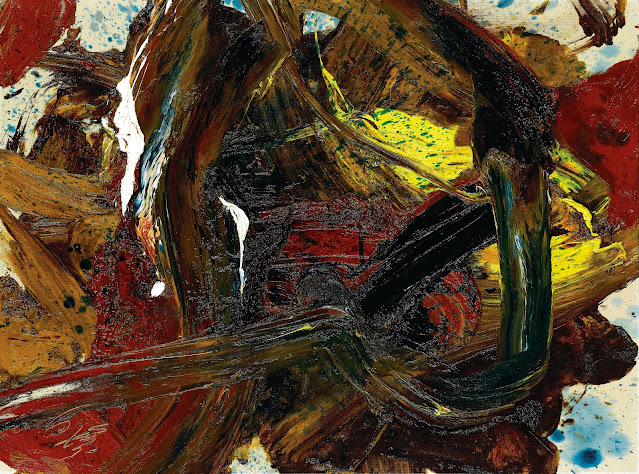
Ingemar Härdelin


  "... the paintings may speak for themself. They live their own lives behind the words.
But something overall may be said after all. I choose to summarize most of my production under the term "motion". Since I througout adult life has been a performing cellist on the side of my civilian profession, has music in mostly been a driving force and inspiration. Music is movement, and movement is an expression of life.
In the same way I experience my painting. In colors is life, music, rhythm. In colors and forms are everything we recognize, but in addition there are infinite opportunities for new discoveries and experiences. We may be affected, seduced, upset and make voyages of discovery in constant dialogue with what we see. Seeing a picture is like hearing a peace of music over and over again. The experience will never be the same.
Most of the time I paint from inner visions where freedom, imagination, rhythm, form and balance are important keywords.
Thus, the same criteria that characterize music. The result is often inpredictable because new opportunities are opening up in the becoming, which in turn can bring the painting into new and surprising paths.... " ( Ingemar Härdelin  absolutearts.com )

More


Milena Olesinska - Abstract Artwork


 Abstract art uses visual language of shape, form, color and line to create a composition which may exist with a degree of independence from visual references in the world. Western art had been, from the Renaissance up to the middle of the 19th century, underpinned by the logic of perspective and an attempt to reproduce an illusion of visible reality. By the end of the 19th century many artists felt a need to create a new kind of art which would encompass the fundamental changes taking place in technology, science and philosophy. 

My Website 


Ben Culwell - Abstract Expressionism Artworks


 Ben Culwell  (1918— 1992)
"It is for the important average that I want to speak, the rank and file. The general nature of the use I try to make of the art of painting is, I hope, apparent: that is, to express the sum of relationships which is a total human being. With art, as with atomic physics, the big problem in the world today is to bring the human being abreast of the techniques and the inventions of his material culture—to achieve an adequate modern spiritual integrity."-- Ben Culwell,
A San Antonio native, Culwell was reared in Houston and graduated from high school in Dallas.  After declining a scholarship offered by the Dallas Art Institute, he studied two years at Southern Methodist University, Dallas, and in 1936 Columbia University, where his instructors included Walter Pach.  In 1937 Culwell returned to Dallas and worked for an insurance company.  He began to exhibit his works and taught at the Texas State College for Women, Denton (1940-41)until he enlisted in the U.S. Navy in October 1941.
War with Japan began while Culwell was on a transport bound for Pearl Harbor.  Beginning in January 1942, he served in the Pacific on the heavy cruiser USS Pensacola, primarily as a captain's yeoman, receiving three campaign ribbons and thirteen battle stars.  During the 1942 Battle of Tassafarongo off Guadalcanal, the Pensacola was hit by a torpedo, resulting in an explosion that killed or wounded 1,300 of the crew.  After a year of repairs, the cruiser returned to the South Pacific war with Culwell aboard.  In 1944 he left the Pensacola for reserve midshipman training at Cornell University, from which he was commissioned ensign.  He also attended Colgate University.
After the war, Culwell settled in Dallas and pursued concurrent careers as a painter and successful businessman in insurance.  His business took him to San Antonio in 1950 to open a new office.  He Returned to Dallas in 1954.  In 1961 he moved to Temple, where he became president of American Desk Manufacturing Company, retiring in 1974 to paint full time.  Culwell died in a Marlin hospital and was buried in Temple.


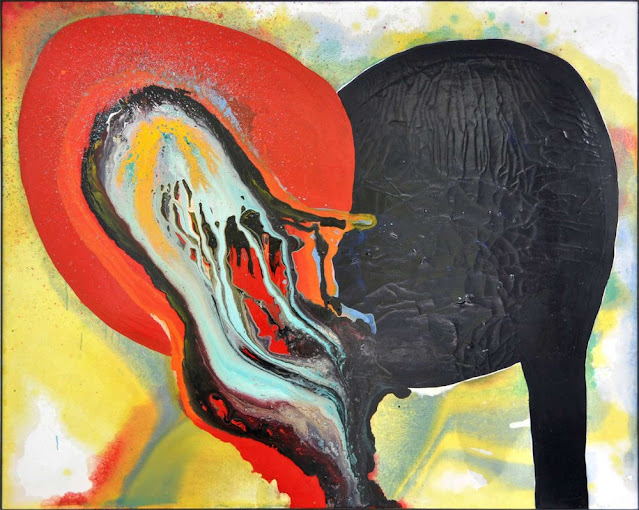
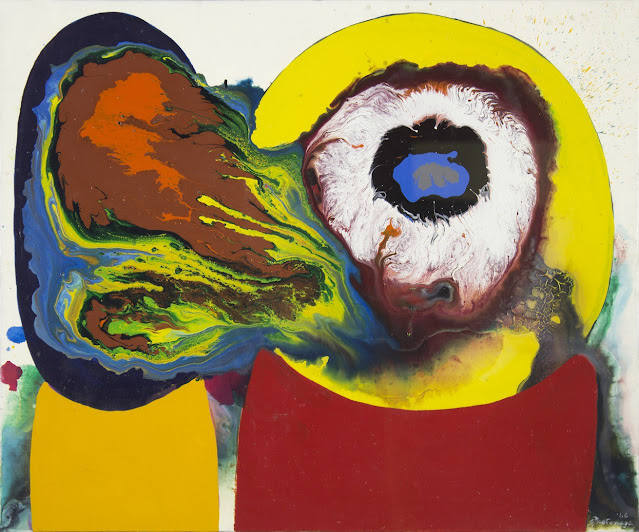
Sadamasa Motonaga - Gutai Group


 Sadamasa Motonaga (Japanese, 1922–2011) was a Japanese abstract painter and a founding member of the avant-garde Gutai group. He was born on November 26, 1922 in Mie Prefecture, Japan and initially sought to be a cartoonist before turning his attention to painting, studying under the tutelage of Jiro Yoshihara. A pronounced sense of humor remained in his work throughout his lengthy career, creating paintings which are characterized by simple lines and a gentle palette of muted primary colors. Motonaga gradually expanded his practice to include printmaking, stage design, and children’s books, all while continuing his ongoing elliptical investigation into abstract painting. His awards include the Légion d’Honneur from the French government and the Japanese Purple Ribbon Award; he was the first abstract artist to receive the latter. He died on October 3, 2011 in Kobe, Japan, and his work has been the subject of many retrospectives, including at Hyogo Prefectural Museum of Art in Kobe in 1998, Hiroshima City Museum of Contemporary Art in 2003, and the Mie Prefectural Museum of Art in 2009. The first Western retrospective of his work was held at the Dallas Museum of Art in 2014.(artnet.com)


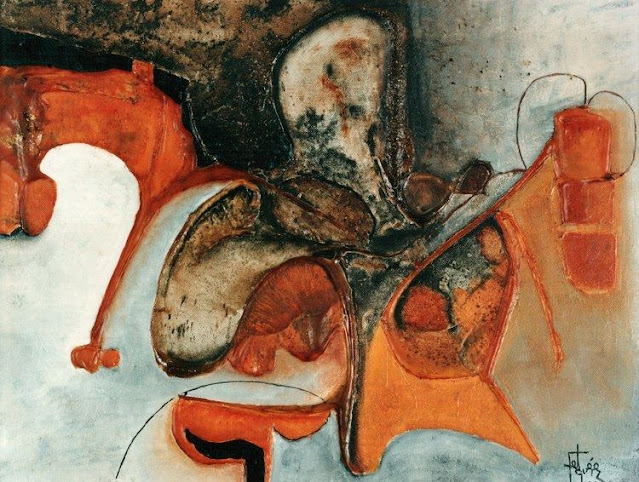
Manuel Felguérez Barra


 Manuel Felguérez Barra (1928 – 2020) was a Mexican abstract artist, part of the Generación de la Ruptura that broke with the muralist movement of Diego Rivera and others in the mid 20th century.
"Painter and sculptor. In the late forties, he studied at the San Carlos Academy in Mexico City. At the beginning of the fifties, thanks to a scholarship from the French government he traveled to Paris where he studied at the Academy de la Grande Chaumier and at the Colarossi Academy. There he perfected his sculptural work with the master Ossip Zadkine, whose work will influence the young Felguérez. In the mid-fifties he became one of the pioneers of the Abstract trend, provoking a true renewal of the Mexican visual arts landscape in the second half of the XX century. Between 1965 and 1990 he developed an intense teaching and research work that took him to Cornell University and Harvard University in the United States. He tought Composition Classes in the National School of Plastic Arts and 1977 he became a researcher at the Institute of Aesthetic Research at UNAM. The work of Felguérez poses a dialectic between abstraction and expression. His paintings articulate geometric figures as squares, triangles, circles or rectangles, that collides with the imprint of an expressive Informalism charged with gestural spontaneity."(durbansegnini.com)