Exposition Art Blog: Israeli painter
Showing posts with label Israeli painter. Show all posts

Igael Tumarkin


Igael Tumarkin ( 1933 – 2021) was an Israeli painter and sculptor

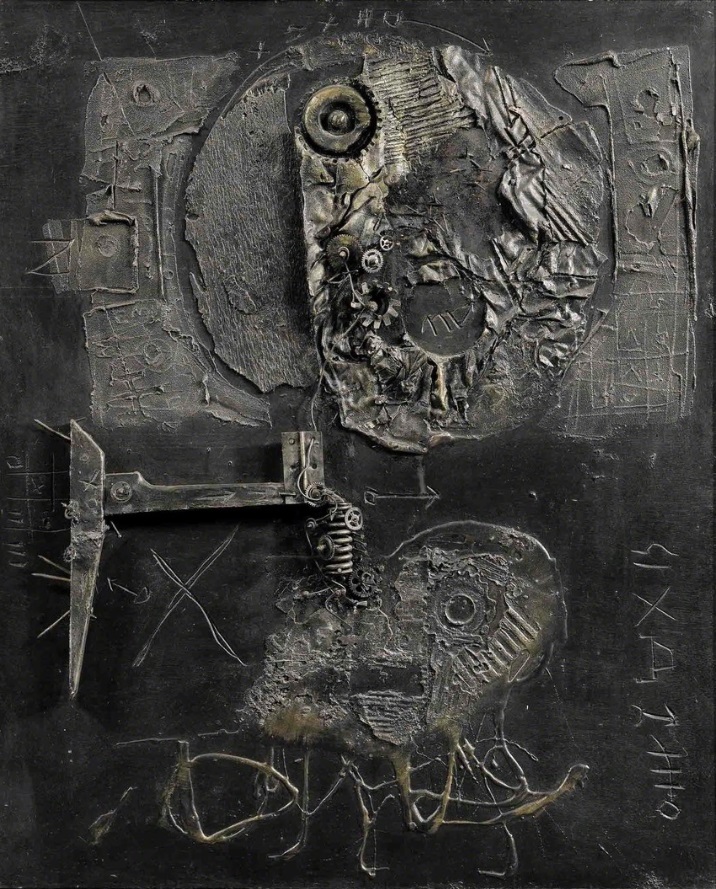
"Renowned Israeli artist Igael Tumarkin is internationally recognized for his public sculptures, paintings, and prints, as well as his divisive political views. A winner of the Israel Prize, Tumarkin was widely known for his anti-war politics, disdain for religion, and protest against West Bank settlements. His most famous sculpture, Monument to the Holocaust and Revival (1975), located in Tel Aviv’s Rabin Square, has been an integral site of political speech, including by performance artist Ariel Bronz. Born in Germany, Tumarkin immigrated to Israel as a child. As a young artist, he studied under sculptor Rudolf Lehmann and worked at Bertolt Brecht’s Berliner Ensemble. His prints and paintings combine aspects of Abstract Expressionism, Dada, and Pop art. Tumarkin represented Israel at the Venice, São Paulo, and Tokyo biennials. The Tel Aviv Museum of Art staged a major retrospective in 1992."(.artsy.net)Tumarkin was also an art theoretician and stage designer. In the 1950s, Tumarkin worked in East Berlin, Amsterdam, and Paris. Upon his return to Israel in 1961, he became a driving force behind the break from the charismatic monopoly of lyric abstraction there. Tumarkin created assemblages of found objects, generally with violent expressionist undertones and decidedly unlyrical color. His determination to "be different" influenced his younger Israeli colleagues. The furor generated around Tumarkin's works, such as the old pair of trousers stuck to one of his pictures, intensified the mystique surrounding him. 


Avigdor Stematsky


Avigdor Stematsky (1908–89) was a Russian-born Israeli painter. He is considered one of the pioneers of Israeli abstract art.Stematsky was born in 1908 in Odessa. He joined the Massad group in Tel Aviv. In 1929, he went to Paris to study at Académie de la Grande Chaumière and Académie Colarossi. He was one of the founders of the New Horizons group. He held his first solo exhibition at the Tel Aviv Museum of Art at the age of 31. In the constellation of Israel art, Stematsky and Yehezkiel Streichman stand out as a pair. Although each developed his own distinct, individual style, there are many points of affinity between them: a common background as students of Bezalel in the 1920s, a response to the influences of the Jewish School of Paris in the 1930s, and of the "modern" (late cubist) art in the 1940s and fifties, when they were also leading teachers in Tel Aviv.Wikipedia


https://milenaolesinska.blogspot.com/p/blog-page_50.html

Michael Gross - Israeli Painter, Sculptor and Conceptual Artist


Michael Gross ( 1920 – 2004) was an Israeli painter, sculptor and conceptual artist.Michael Gross was born in Tiberias in the British-administered Palestine in 1920. He grew up in the farming village of Migdal. In 1939-1940, he left to study at the Teachers’ Training College in Jerusalem. In 1939, while he was away, his father was murdered by Arabs, and the family farm and home were destroyed. This event impacted on his work as an artist.From 1943 to 1945, he studied architecture at Technion – Israel Institute of Technology in Haifa. From 1951 to 1954, he studied art at the École nationale supérieure des Beaux-Arts in Paris. He returned to Israel in 1954 and settled in the artists’ village of Ein Hod.
"After making drawings and paintings of plants, landscapes, and buildings over many years, I decided to try abstraction. This change opened up a new world for me to explore how I could express my feelings—at times, joy, at other moments, sorrow, as well as pain and fear—more directly. This gave me far greater power and the freedom to experiment continually.The painters who have influenced me most are Jackson Pollock, Willem de Kooning, and Richard Diebenkorn, whom I consider the pre-eminent artists of abstract expressionism. I have tried to emulate them in my own small way.My choice of paints has varied. Earlier in my career, I used oil predominantly and, more recently, acrylic. For the last several years, I have moved towards much brighter colors in more open space, and to significantly larger canvases. Most of the works in this exhibition use at least two canvases together to create the final work.Over time, my color palette has evolved. Before the paintings in the American University Museum exhibition, I spent a number of years focusing on making paintings that were predominantly monochromatic (black, yellow, red, etc.) with subtle inclusion of other colors onto the surface, as well as from underneath.I use yellow in many shades as well as orange, green, and blue, with brown as an accent, making connections between the larger yellow sections. There are many extended narrow lines in black as well as other colors that weave the work together. I work rapidly, pacing the studio to look at the painting up close, and then from a distance. I often rotate the canvas so I can see where there is imbalance, flinging paint to create lines and movement. This new focus has produced very large paintings that are filled with color, carefully constructed so that every mark attains its rightful place in equilibrium."Michael Gross ( michaelgrossart.com )


Moshe Gershuni

Moshe Gershuni (11 September 1936 – 22 January 2017) was an Israeli painter and sculptor. In his works, particularly in his paintings from the 1980s, he expressed a position different from the norm, commemorating The Holocaust in Israeli art. In addition, he created in his works a connection between bereavement and homoerotic sexuality, in the way he criticized society and Israeli Zionism-nationalism. He was awarded the Israel Prize for Painting for his work in 2003, but in the end it was revoked and he was deprived of receiving the prize.
"At the heart of his paintings are amorphous stains; hand-written phrases are their iconographic counterparts, functioning as directive anchors for the viewers. They link the corporeal and abject with the conceptual in Gershuni’s work. Paintings from the series Hai Cyclamen (1983 – 85) feature bent, undulating flowers that form elliptical loops, flames and infinity symbols, as well as incomplete verses taken from death rituals or passages conveying God’s mercy. The Binding of Isaac, perhaps the most powerful motif in Jewish-Israeli representational language, transmutes onto the canvas into the Yiddish, Eastern European pronunciation of ‘Isaac’. Works from his The Soldiers series (1981) similarly references filicide, though here the sons are no longer defenceless. The paintings’ blood reds also seem to question Israeli occupation almost 15 years after the Six Day War. At the same time, the soldiers, conjured in the paintings by language alone, also become objects of homoerotic desire: inscribing the red stained works with a discursive ‘Shalom Soldier, How Are You?’ or ‘Good Soldier’, Gershuni, who came out in 1980, shows himself as a flirtatious provocateur. Three works from 1998 feature the titular ‘No Father No Mother’, an allusion to Georg Büchner’s famous play about the soldier Woyzeck (1879). Gershuni’s search for identity as a Jewish and an Israeli artist has resulted in an orphan state: he broke away from the post-minimalism of his peers, yet as a painter belonging to a non-iconographic tradition, his tools became stain and written word. ‘I’m an Israeli because I am Jewish,’ Gershuni wrote in 1982, in the context of secular Israeli cultural debates over themes of Jewishness, offering one answer to the show’s opening challenge. Yet his Zionism is far more nuanced than the definition the term assumes in light of recent political developments. In 2003, Gershuni rejected the ‘Israel Prize’, the state’s highest honour, because he refused to shake hands with then Prime Minister Ariel Sharon, as he would have had to at the ceremony. No Father No Mother, planned months in advance, opened after a summer of bloodshed in the region. Through Gershuni’s depictions of multiple complexities, this show in Berlin, in the autumn of 2014, is a reminder that the conflict can’t be reflected in simplistic binaries." ( Hili Perlson  frieze.com )