Exposition Art Blog: Polish contemporary sculptors
Showing posts with label Polish contemporary sculptors. Show all posts

Władysław Hasior - Polish contemporary sculptors

Władysław Hasior ( May 14, 1928 – July 14, 1999) was one of the leading Polish contemporary sculptors connected with the Podhale region. He was also a painter and theatre set designe.Władysław Hasior was born in Nowy Sącz on May 14, 1928. From 1947-1952, he studied under Professor Antoni Kenar at the State Secondary School of Visual Art Techniques. In 1952 he started his studies in sculpture at the Academy of Fine Arts in Warsaw. He graduated from the Academy in 1958. From 1959-60, he stayed in Paris as a holder of a scholarship of the French Ministry Culture and studied under Ossip Zadkine. His first individual exhibition was in 1961 at the Jewish Theater in Warsaw. Since then his works have been displayed at over seventy individual exhibitions in Poland and Europe. In 1968 Hasior had returned to his first school and became a teacher there until 1968.
Hasior’s art meant to provoke and shock the beholder. He continuously experimented with forms, techniques and materials by creating spatial compositions, assemblages and collages. He also authored many unconventional monuments and plein air sculptures, both in Poland and abroad. Since 1984 artist focused on the continuous arrangement of the authors Gallery.Władysław Hasior died on July 14, 1999 in Kraków. He is buried at the Zakopane Cemetery of the Meritorious at Pęksowy Brzyzek.Wikipedia
"Władysław Hasior was one of the most prolific contemporary Polish artists. He was an extraordinary personality, and a very colourful and magnetic individual. In the West, he was hailed as "the most talented student of Rauschenberg and Warhol". In Poland, his work is considered as a precursor to pop art and assemblage, despite the artist's obstinate insistence that he had "never suffered from modernity". Hasior regarded artistic activity as an intellectual and creative provocation, and he perceived modernity as rooted in a culture whose language was universal.
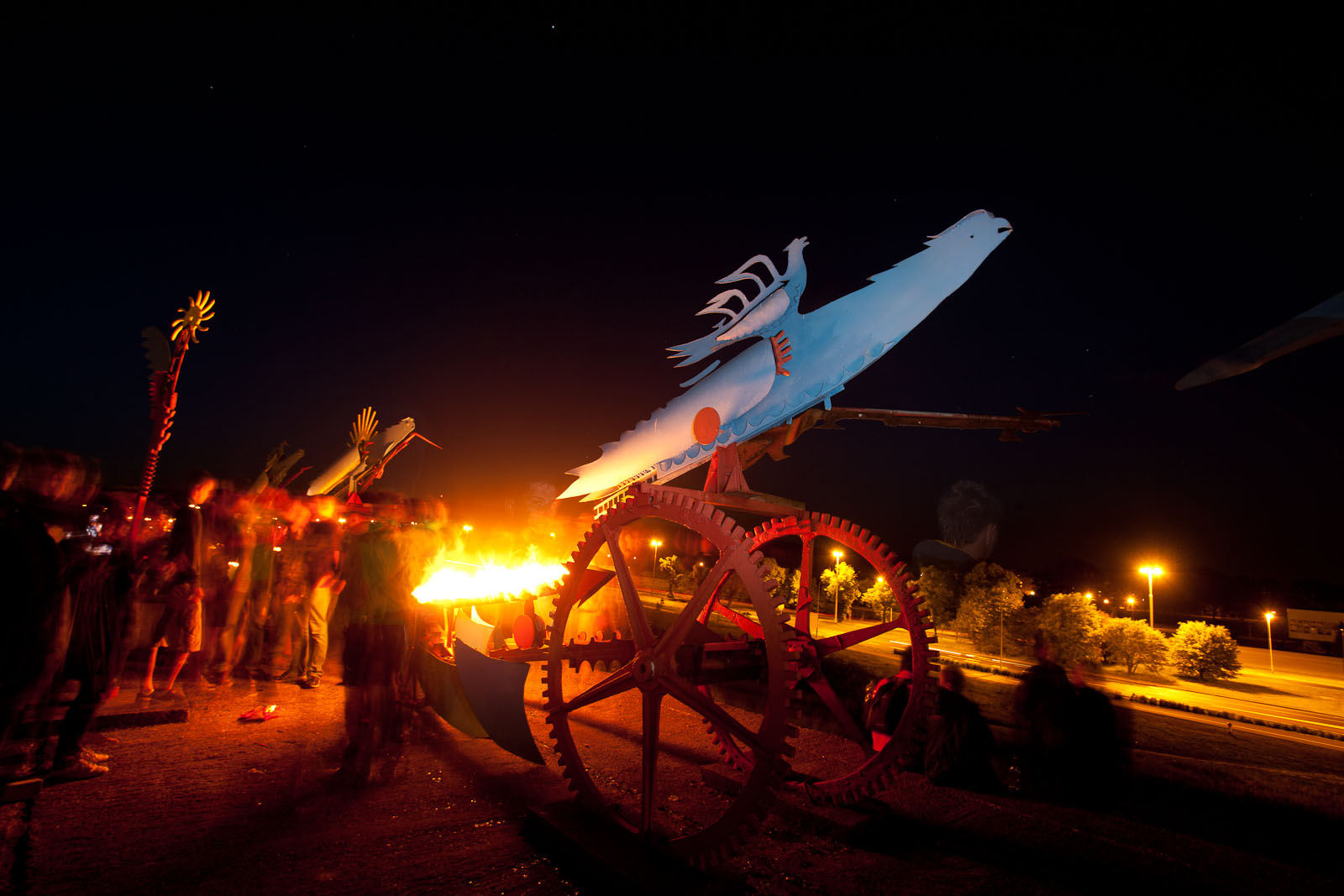
He entered the art world in a manner that immediately drew the attention of the general public, and soon after became a "cult" artist for the 60s and 70s generations. His work shocked and delighted, aroused extreme emotions and judgement, and his controversial attitude compelled audiences to ask questions about the nature of art, and the artistic license of choosing the language of expression. As one of the few such artists of the time, he gained a level of popularity typically enjoyed by celebrities of film and stage.He was a sculptor, although many of his works are difficult to be categorized precisely in terms just sculpture. He became famous as a total artist, working on the borders between many artistic genres: painting, sculpture, architecture, arts and crafts. In 1958, he abandoned classical sculpture in favour of "something" which his contemporaries could not yet fully define. In his art practice, he employed a collage technique to create assemblages, namely, semantically rich three-dimensional compositions incorporating various found objects and finished works.Hasior used degraded elements of technological civilization as art materials. He built structures out of everyday objects or fragments thereof, thus restoring their significance. In this fashion, he engaged in a continuous dialogue with Polish reality and mythology, a dialogue leavened with poetry, but also with mockery and irony. The relevance of Hasior’s artistic attitude lies in his authenticity, and in his acute powers of observation which encompassed sociology and culture, combining tradition and modernity, high and low culture."( Culture.pl )




Marek Kijewski

"Marek Kijewski is a sculptor. He was born in 1955 in Gdańsk, and died on August 19th 2007 in Warsaw.
A student of Warsaw's Academy of Fine Arts from 1981 to 1985, he graduated in sculpture in the class of Professor Jerzy Jarnuszkiewicz. Between 1985 and 1987, he was a member of the Neue Bieriemiennost group with Miroslaw Bałka and Miroslaw Filonik. From 1996, he worked with Małgorzata Malinowska/Kocur as an artistic duo. He lived and worked in Warsaw.
Right after his studies Marek Kijewski created figurative sculptures that were close to "new expression" in style. His pieces and spatial installations were characterized by an ironic perversity, and their titles were an integral part of the messages poetics (With Arm and Sword / Żywią I bronią, The Meditations of King Sigismund III About a Woman Fallen in Spirit / Rozmowa Zygmunta Trzeciego na temat kobiety upadłej na duchu). Towards the end of the 1990s, Kijewski slowly stripped his works of expressiveness and figurative forms in favour of a contemplative edge and a search for the mystical, abstraction. After a period of simplifying forms, he gradually deprived his sculptures of a physical dimension, creating projects which primarily used light (incandescent and neon) as their material. He also introduced colour (primarily blue, red and white) into his sculptures and its symbolism as defined by the Orthodox theologian Paul Florensky. This became a very important motif in Kijewski's later projects, in which the artist transformed colour symbolism into one of the primary semantic tools of his work.


In the mid-1990s Kijowski expanded his interests to include contemporary visual culture, mainly mass culture, and he began using completely non-artistic materials in his pieces which were often everyday objects (e.g. Fred Flinstone from Knossos – concrete, polyurethane foam, peacock feathers, ripe bramble candies, green bramble candies, bull horns, gum; John Cage’s Portrait – beer cans, a marble lamb, condoms, gum; I’m Pregnant – walnuts in shells, plywood, gum; Queen Midas Looking for Bugs – Lego blocks, concrete, 24 carat gold, gum. He combined these new interests with a continued focus on high art, allusions to the canons of world culture, references to philosophy and religion. This sphere of references is reflected in his use of precious materials liked gold flakes, bronze, hallucinogenic drugs, and precious stones, and in the links he preserves to classical sculptural forms like totems, obelisks, monuments, busts, and equestrian statues. These surprising combinations of various materials, forms, motifs and traditions from the repository of both high and low culture result in the creation of an unusually original, highly subjective, yet extremely familiar set of meanings which defines the thoroughly contradictory spirituality of the post-modern era.


Kijewski/Kocur came to use the term SSS (surfing, scanning, sampling) to refer to the creative strategy or method used in the later years of their cooperation. The individual components of the name are familiar to computer/Internet users and to creators of rap, hip-hop and techno, in which the underlying tracks are composed of selected samples of already existing music. 
   " This concept allows us to perform our own intellectual surfing through culture. We move through this space, freely scanning any elements we view as significant, to the past, present or future. These fragments, deprived of their identity, constitute the material which is sampled in the computers of our imaginations."


Based on elementary icons, the artists created works which were semantic hybrids, juxtaposing religious and mystical motifs with pop-culture icons like Simon Templar, Bugs Bunny, or the Flintstones, the Suprematist works of Malevich with computer bits, and Andy Warhol with a centaur. Their works are visually attractive, replete with subtle humour, and above all inspire us to a multitude of interpretations and to embark on the many cultural paths which intersect within them.
Around the year 2000 Kijewski returned to primary forms in his pieces. Around the same time the system Ethical Bits was created, which related to the dichotomies of good vs evil and mind vs matter, and visual constructions which represent them. Bits, the smallest elements of computer space, were combined in this system with the colour symbolism adopted by the Orthodox Church, Malevich’s Suprematism and the colour gold representing energy. Kijewski intended the Ethical Bits language to aid our passage into the world of new spirituality (third millenium). Bites are shaped in the form of a cube or the letter T, made of plastic with dimensions based on the elementary numerological scale from 1 to 9. He used them to build architectural constructs called ‘gates’: Heaven Gates, Papa Gates, Hell Gates, Bill Gates, and Golden Gates, as well as bas-reliefs which were an expansion of this system in a plane.


In 2003, the artistic duo presented billboard art at the exhibition entitled Three Triptychs +... at the Arsenal Gallery in Poznań. ‘It is something completely different than large scale advertising boards. We transform billboards into practically painting planes.’ That is what happened with Fokus 1, where the image of a B2 bomber transformed on the billboard into a uniform, nearly abstract structure or the piece Invasion representing a figure of Mao Tse-tung multiplied. The gold Mao figure repeated numerous times fills the whole space as though they were an army of praying clones. The artists raised the issue of media coverage of wars, transforming a horror into a visually attractive reproductive material.
In 2007, Kijewski invited a group of artist friends of his to a open-air workshop entitled Bifurcations. Among them were Małgorzata Malinowska, Piotr Kurka, Robert Rumas, Julita Wójcik, Joanna Rajkowska, Oskar Dawicki, Robert Jurkowski, Leszek Golec, Tatiana Czekalski, Mirosław Bałka and Tomasz Stańko. During his stay in Orońsko, Kijewski created a prototype of his work First Element, that was supposed to consist of thirteen figurines of dogs cast in resin. There was a huge heart ‘growing’ out of each of their chest – Kijewski planned to place a small amount of explosive material inside them for the post workshop exhibition, so that the dogs' hearts would explode (yet he resigned from the idea for safety reasons). The twelve figurines in blue, red and one in gold were symbolically referring to the spirit (blue), matter (red) and pure energy (gold). The installation was never finished as the artist died shortly after the workshop. However, it was possible to reconstruct it based on sketches and the prototype design. It was then presented along with the other artist’s pieces at the post workshop exhibition Bifurcations in Orońsko in 2008."
Author: Ewa Gorządek, CCA Ujazdowski Castle, October 2004; up-date: June 2009, Translated by: Zuzanna Wiśniewska, September 2015 (culture.pl/en/artist/marek-kijewski)


Władysław Hasior

Władysław Hasior ( May 14, 1928 – July 15, 1999) was one of the leading Polish contemporary sculptors connected with the Podhale region. He was also a painter and theatre set designer
Władysław Hasior was born in Nowy Sącz on May 14, 1928. From 1947-1952, he studied under Professor Antoni Kenar at the State Secondary School of Visual Art Techniques. In 1952 he started his studies in sculpture at the Academy of Fine Arts in Warsaw. He graduated from the Academy in 1958. From 1959-60, he stayed in Paris as a holder of a scholarship of the French Ministry Culture and studied under Ossip Zadkine. His first individual exhibition was in 1961 at the Jewish Theater in Warsaw. Since then his works have been displayed at over seventy individual exhibitions in Poland and Europe. In 1968 Hasior had returned to his first school and became a teacher there until 1968.


 Hasior’s art meant to provoke and shock the beholder. He continuously experimented with forms, techniques and materials by creating spatial compositions, assemblages and collages. He also authored many unconventional monuments and plein air sculptures, both in Poland and abroad. Since 1984 artist focused on the continuous arrangement of the authors Gallery.
Władysław Hasior died on July 14, 1999 in Kraków. He is buried at the Zakopane Cemetery of the Meritorious at Pęksowy Brzyze


Gallery devoted to Hasior's work has existed since 1984 and is situated in the interior of the ‘deck-chair rental’ by the ‘Warszawianka’ Hotel, a building that was built prior to World War II when Zakopane was an antituberculosis resort and bed rest in the open air was a common form of treatment.
Officially, Hasior’s Gallery is a branch of the Tatra Museum, which the artist enriched with a "dowry" of around one hundred of his works. They constituted the bases for the permanent exhibition made available to the visitors on the ground floor of the building. This is the exhibition which the host of gallery continuously developed and altered, building some kind of a total work, a unique installation of his own exhibits, he created a magical space imbued with music, light, and turned unreal with reflection of huge mirrors. Wikipedia