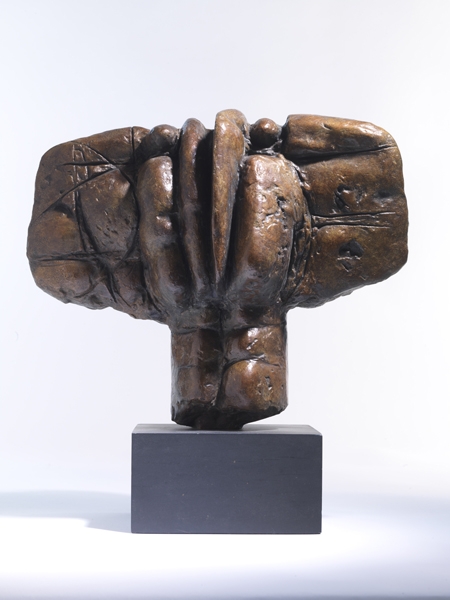
Stephen De Staebler (March 24, 1933 – May 13, 2011) was an internationally celebrated American sculptor, best recognized for his work in clay and bronze. Totemic and fragmented in form, De Staebler's figurative sculptures call forth the many contingencies of the human condition, such as resiliency and fragility, growth and decay, earthly boundedness and the possibility for spiritual transcendence. An important figure in the California Clay Movement, he is credited with "sustaining the figurative tradition in post-World War II decades when the relevance and even possibility of embracing the human figure seemed problematic at best."De Staebler's ceramic sculptures harness the inherent qualities of clay, his primary medium during the earlier years of his career, to create raw, fragmented indexes of the body, the landscape and even the landscape as body. The equally organic and preternatural qualities of his forms evoke the tenuous relationships between earthly monumentality and spiritual transcendence, fragmentation and wholeness, and fragility and strength. This tendency for slippage serves a productive purpose, allowing the works to inhabit the discursive space between more prescriptive categories. Seated Figure with Yellow Flame, in the collection of the Smithsonian American Art Museum is a typical example of his anthropomorphic works. In the late 1970s, De Staebler turned to bronze after an injury temporarily curtailed his ability to create large-scale, ceramic figure columns. His interest in such a classical art historical medium might strike as counterintuitive, however De Staebler adapted the casting process to reflect his more deconstructed, liberated approach to art-making. Wikipedia
Painting is like silent poem, said Simonides, poet from ancient Greece.Paintings are icons, doors to the Platonian world above the heavens. Paintings on my blog are just those icons, which lead a viewer into the magic world of harmony and beauty. Artists who present their achievements on my blog have a very different cultural and national background, they represent variety of artistic traditions and schools
Showing posts with label figurative sculptures. Show all posts
Boaz Vaadia - Sculptures in Metal and Stone
Boaz Vaadia (November 13, 1951 – February 25, 2017) was an Israeli-American artist and sculptor who worked primarily in stone and subsequently by casting in bronze. Based in New York City since 1975, his studio is located in Brooklyn. The power of natural materials and the relation of human beings to that power determine the content of Vaadia's sculpture. Vaadia said of his work, "I work with nature as an equal partner. The strongest thing I address is that primal connection of man to earth. It's in the materials I use, the environments I make, and the way I work.
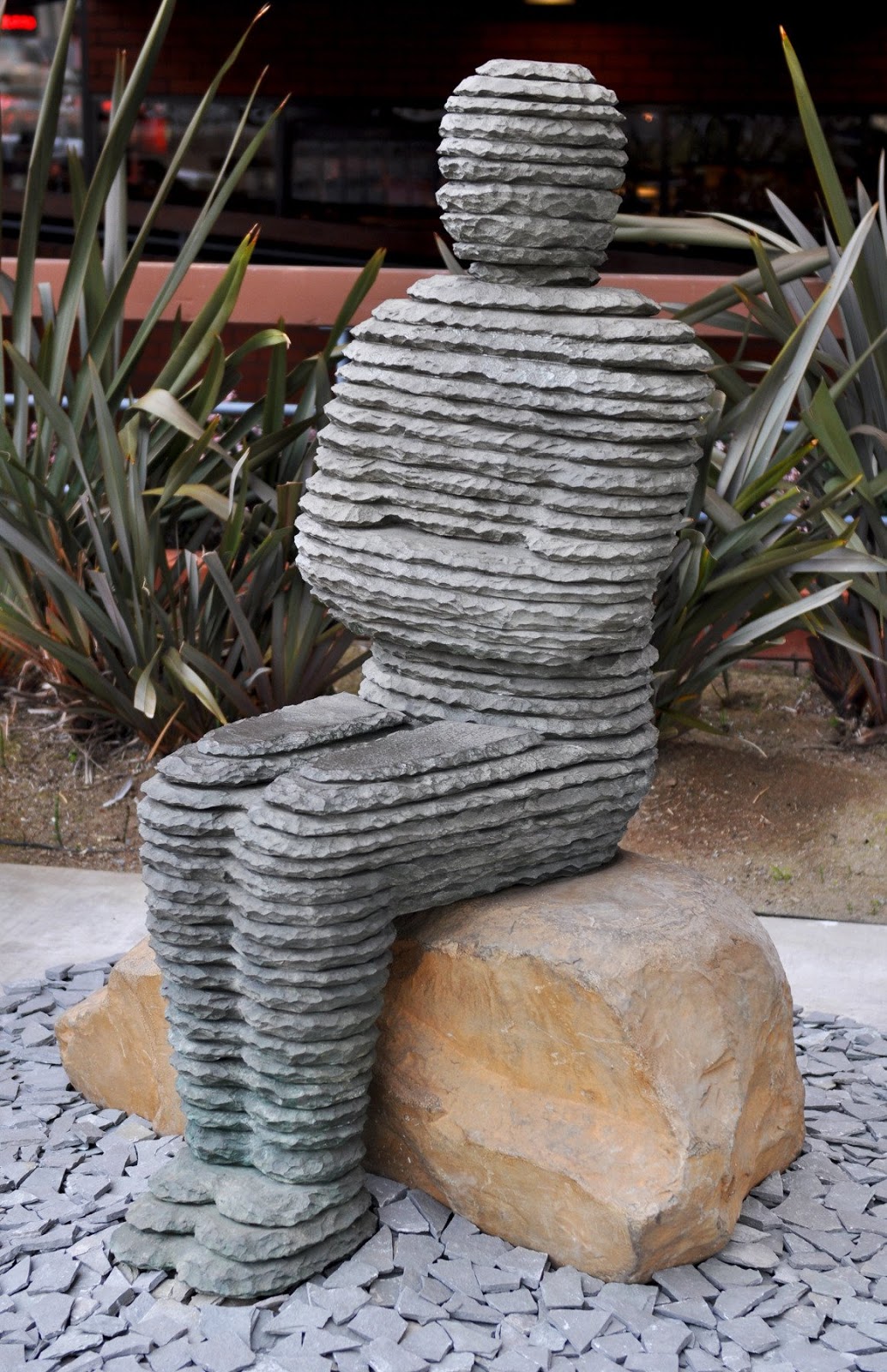
Beginning in 1985, Vaadia turned his efforts toward figurative motifs executed solely in stone. Retained from previous efforts was the utilization of gravity as a force in maintaining stability. For these body-based forms, his methodology entailed stacking gradated rock sheets in a formation suggestive of individual stones modified by chisel-marked surfaces.Vaadia says, "It was quite an exciting moment for me when I realized that I actually could go back to figurative work and still have the respect for the way the bluestone and slate are formed in nature…" By chipping away unwanted rock, Vaadia took advantage of the way nature layers sediment. Using traditional tools - hammer and chisel - he molded each single stone to suit the whole composition. As a result, this work reflects sculptural techniques which parallel natural transformations in stone. The artist's stratification of stones echoes natural conversions of matter.This development within his work opened up a long period of great creative output and recognition. Vaadia understood that his chosen materials limited what could be built with them, and by respecting the structural properties of bluestone slabs, he created an artistic restriction for himself: each one of his sculptures must be able to stand and to hold together bound only by the force of gravity (though ultimately bolted together for safety and permanency). As a result, he has knowingly limited himself to stable, compact poses, and a generalized human form that alludes to Easter Island moai, Egyptian Pharonic sculpture, and Buddhist repose.Wikipedia
Ralph Brown
Ralph Brown (1928 – 2013) was an English sculptor who came to national prominence in the late 1950s with his large-scale bronze Meat Porters, commissioned for Harlow New Town, Essex and is known for his sensual, figurative sculptures.Like Henry Moore who befriended him and encouraged him by buying his work, Brown's art is deeply rooted in the figurative tradition. However, whilst his predecessors focused their energies on carving and maintaining 'truth to materials', Brown concentrated on modelling allowing him to interact with his material on a more intimate level. In the introductory catalogue essay for Brown's major retrospective show at Leeds City Art Gallery in 1988 Dennis Farr commented: "So much of Brown's sculpture is his search for equivalents, in formal terms, for sensual experiences.Brown came to national prominence in the late 1950s with his large-scale bronze group Meat Porters, commissioned for Harlow New Town, Essex. The piece is a tribute to physical labour with two figures hauling an ox carcass, a subject fitting to the busy market square and a form that brings dynamism to the otherwise rigid architecture. The concrete version of the piece won second prize for sculpture at the John Moore's Exhibition, Liverpool in 1959.Wikipedia
George Grard
George Grard (1901-1984) was a Belgian sculptor, known above all for his representations of the female, in the manner of Pierre Renoir and Aristide Maillol, modelled in clay or plaster, and cast in bronze.
Grard was born in Tournai to a family of modest means and entered the Académie de Tournai in 1915, but his real calling as a sculptor became apparent when he followed a course in sculpture in 1922 with Maurice De Korte (1889–1971). In his native city he met Pierre Caille, and later, in a Brussels foundry, Charles Leplae. Having won the Prix Rubens (1930), he left for Paris, where he encountered the sculpture of Charles Despiau, Aristide Maillol and Pierre Renoir, which influenced his mature style. In 1931, he set up his studio at Saint-Idesbald on the coast, where his house became a rendez-vous of artists including Pierre Caille, the Haesaerts brothers, Edgard Tytgat and Paul Delvaux.In 1935, he was commissioned to create a sculpture for the rose garden at the Exposition universelle et internationale. Two years later Henry Van de Velde asked him for a work for the Belgian pavilion of the Exposition internationale, 1937. In the nineteen-fifties Grard, still in full possession of his mature powers, received repeated public commissions: the Seated Figure at the Banque Nationale, Brussels (1950), La Mer, fronting the post office at Ostend (1955, illustration), the Naïade at Tournai (1950), and Earth and Water, near the Albert Bridge at Liège (1964).George Grard died in Saint-Idesbald in 1984.Wikipedia
Subscribe to:
Posts (Atom)