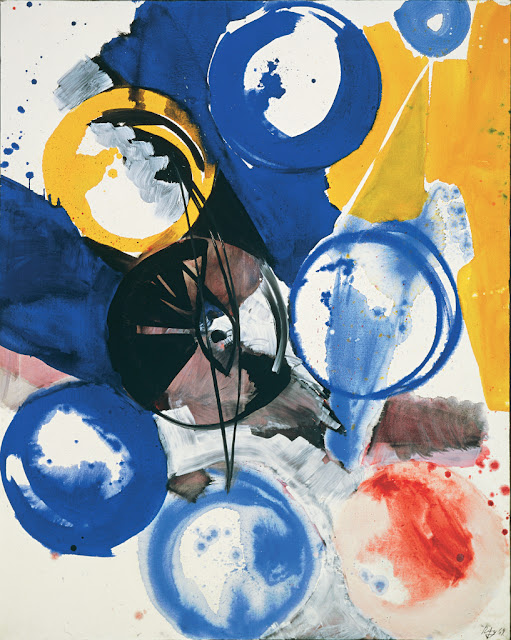
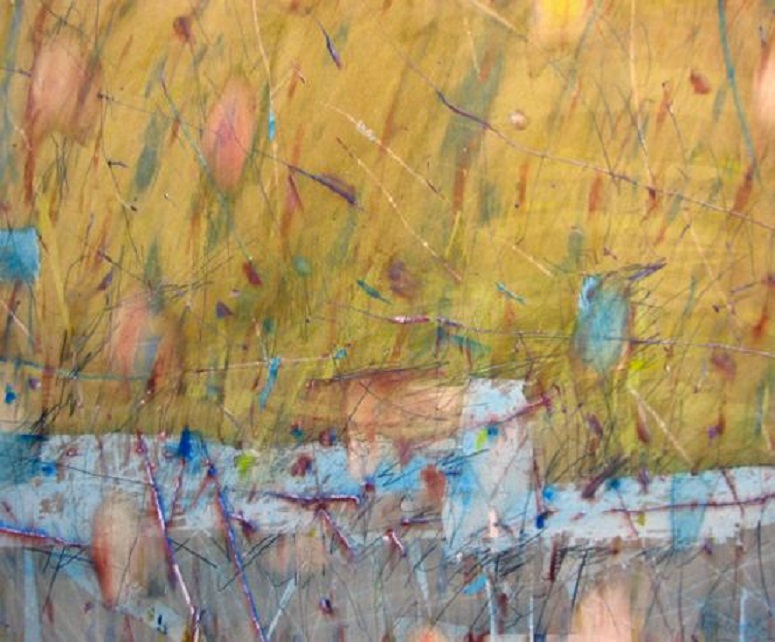
Hans-Jürgen Schlieker (April 8, 1924 – March 12, 2004) was a German abstract painter, grouped in importance with Hans Hartung, Bernard Schultze and Emil Schumacher. Schlieker was born in 1924 in Schöningen (today Grędziec, Poland), East Pomerania, where he grew up and completed a formal education before deciding to study applied arts at a local studio. After a period of focused study, he served as a soldier for three years in the German army, an experience which he later expressed pictorially in flamboyant 50s colours and through artistic work groups.After the war and a temporary stay at an artist’s centre in Mecklenburg, Schlieker moved to Hamburg to study at the Kunsthochschule (arts college) under Erich Hartmann.
Painting is like silent poem, said Simonides, poet from ancient Greece.Paintings are icons, doors to the Platonian world above the heavens. Paintings on my blog are just those icons, which lead a viewer into the magic world of harmony and beauty. Artists who present their achievements on my blog have a very different cultural and national background, they represent variety of artistic traditions and schools
Showing posts with label german abstract painter. Show all posts
Ernst Wilhelm Nay - Art Informel
Ernst Wilhelm Nay (1902, Berlin – 1968, Cologne) was a German abstract painter influenced by L'Art Informel.Ernst Wilhelm Nay studied under Karl Hofer at the Berlin Art Academy from 1925 until 1928. His first sources of inspiration resulted from his preoccupation with Ernst Ludwig Kirchner and Henri Matisse as well as Caspar David Friedrich and Nicolas Poussin. Nay's still lifes, portraits and landscapes were widely acclaimed. In 1931 Nay received a nine-months' study bursary to the Villa Massimo in Rome, where he began to paint in the abstract Surrealist manner. On the recommendation of the Lübeck museum director, C.G. Heise, Nay was given a work grant financed by Edvard Munch, which enabled Nay to spend time in Norway and on the Lofoten Islands in 1937. The "Fischer- und Lofotenbilder" represented a first pinnacle of achievement. That same year, however, two of his works were shown in the notorious exhibition of "Degenerate art" and Nay was forbidden to exhibit any longer. He wasn't even allowed to paint nor buy ready made colours.
Conscripted into the German armed forces in 1940, Nay went with the infantry to France, where a French sculptor placed his studio at Nay's disposal where Nay could paint in secret. In the "Hekatebildern" (1945–48), featuring motifs from myth, legend and poetry, Nay worked through his war and postwar experiences. The "Fugale Bilder" (1949–51) proclaim new beginnings in a fiery palette and entwined forms. In 1950 the Kestner Gesellschaft Hannover mounted a first retrospective of Nay's work. The following year the artist moved to Cologne, where, with the "Rhythmischen Bildern" he took the final step towards entirely non-representational painting. In them he began to use colour purely as figurative values.From 1955 Nay's painted "Scheibenbilder", in which round colour surfaces organize subtle modulations of space and colour. These are developed further in 1963/64 in what are known as the "Augenbilder". A first one-man-show in America at the Kleeman Galleries, New York, in 1955, participation in the 1956 Venice Biennale and the Kassel documenta (1955, 1959 and 1964) are milestones marking Nay's breakthrough on the international art scene.Wikipedia
Ernst Wilhelm Nay
Ernst Wilhelm Nay (1902, Berlin – 1968, Cologne) was a German abstract painter influenced by L'Art Informel.Ernst Wilhelm Nay studied under Karl Hofer at the Berlin Art Academy from 1925 until 1928. His first sources of inspiration resulted from his preoccupation with Ernst Ludwig Kirchner and Henri Matisse as well as Caspar David Friedrich and Nicolas Poussin. Nay's still lifes, portraits and landscapes were widely acclaimed. In 1931 Nay received a nine-months' study bursary to the Villa Massimo in Rome, where he began to paint in the abstract Surrealist manner. On the recommendation of the Lübeck museum director, C.G. Heise, Nay was given a work grant financed by Edvard Munch, which enabled Nay to spend time in Norway and on the Lofoten Islands in 1937. The "Fischer- und Lofotenbilder" represented a first pinnacle of achievement. That same year, however, two of his works were shown in the notorious exhibition of "Degenerate art" and Nay was forbidden to exhibit any longer. He wasn't even allowed to paint nor buy ready made colours.
Conscripted into the German armed forces in 1940, Nay went with the infantry to France, where a French sculptor placed his studio at Nay's disposal where Nay could paint in secret. In the "Hekatebildern" (1945–48), featuring motifs from myth, legend and poetry, Nay worked through his war and postwar experiences. The "Fugale Bilder" (1949–51) proclaim new beginnings in a fiery palette and entwined forms. In 1950 the Kestner Gesellschaft Hannover mounted a first retrospective of Nay's work. The following year the artist moved to Cologne, where, with the "Rhythmischen Bildern" he took the final step towards entirely non-representational painting. In them he began to use colour purely as figurative values.From 1955 Nay's painted "Scheibenbilder", in which round colour surfaces organize subtle modulations of space and colour. These are developed further in 1963/64 in what are known as the "Augenbilder". A first one-man-show in America at the Kleeman Galleries, New York, in 1955, participation in the 1956 Venice Biennale and the Kassel documenta (1955, 1959 and 1964) are milestones marking Nay's breakthrough on the international art scene.Ernst Wilhelm Nay was awarded important prizes and is represented by work in nearly all major exhibitions of German art in Germany and abroad. The first English-language monograph of Nay's work was published by Ridinghouse in 2012.Wikipedia
Ernst Wilhelm Nay
Ernst Wilhelm Nay (1902, Berlin – 1968, Cologne) was a German abstract painter influenced by L'Art Informel.
Subscribe to:
Posts (Atom)