Exposition Art Blog: american painter
Showing posts with label american painter. Show all posts

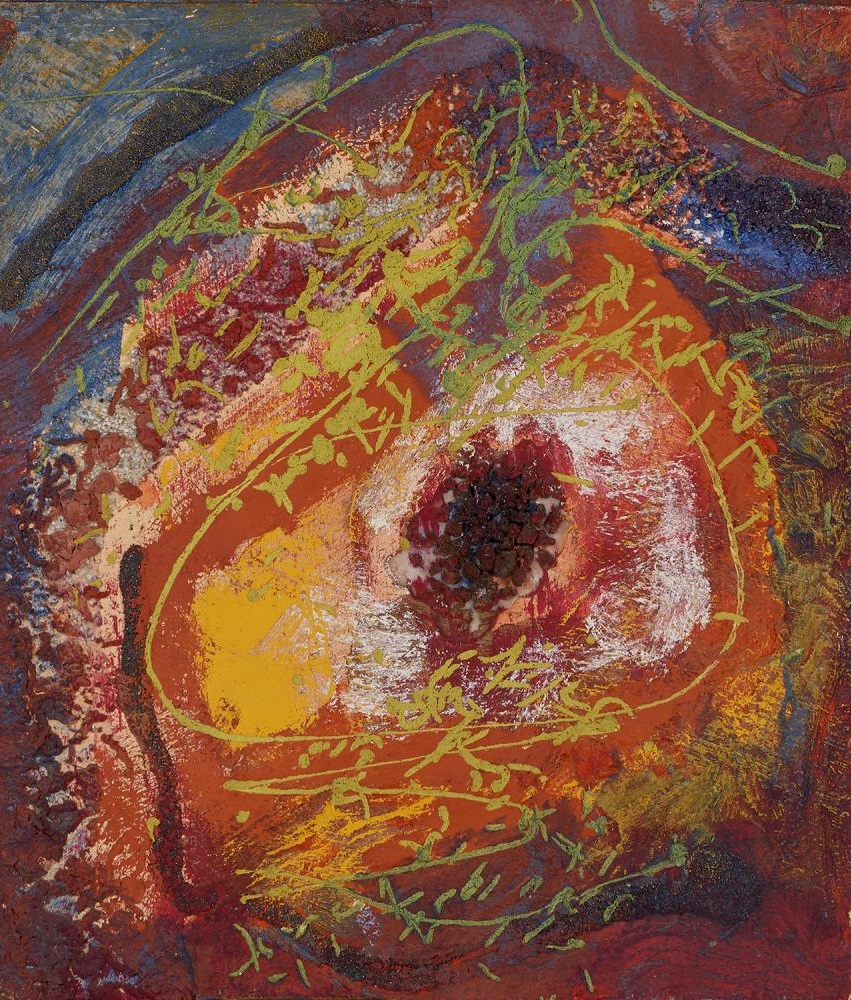
Nicholas Hondrogen contemporary abstract painting

 Nicholas Hondrogen (1952-2007) was a prolific painter, sculptor, and filmmaker. A part of the art-star generation of 1980s New York, Hondrogen had more in common and spirit with the Minimalists and Conceptualists of decades prior. The artist began his career in Paris in the early 1970s following an accelerated course of study at the Boston Museum School. Achieving almost immediate recognition in Europe, Hondrogen enjoyed numerous solo exhibitions and was collected by both individuals and notable public institutions. He returned to the U.S. in the early 1980s, settling in New York City where he founded a successful design and construction business and refocused his art toward filmmaking. Hondrogen’s award-winning 1997 film, Perfect Moment, created after his move to Los Angeles, documents the life-defining recollections of a wide-range of individuals both famous (Philip Glass, Vincent Gallo, Norman Lear) and unknown. Hondrogen was the recipient of two Pollack-Krasner grants in 2000 and 2005.
The Nicholas Hondrogen Trust was formed in February 2007 at the time of the artist’s death. Hondrogen’s long time patron and supporter Jeff Vespa was chosen to chair the estate, with the artist’s brother John acting as a trustee. Hondrogen's Mumonkan Series marked the Trust’s inaugural show.(wunderarts.com)


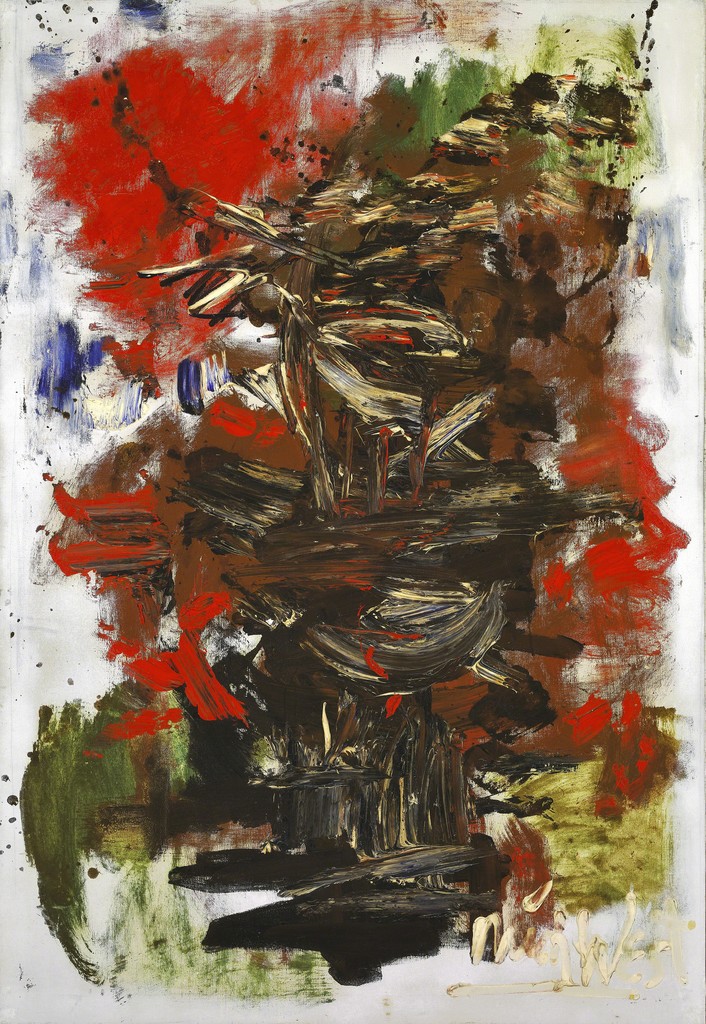
Corinne Michelle West - Action Painting


 Corinne Michelle West (1908–1991) was an American painter; she also used the names Mikael and Michael West.She was an Abstract Expressionist.West was born in Ohio. She attended the Cincinnati Conservatory of Music before moving to the Cincinnati Art Academy in 1925.She moved to New York in 1932. She was Arshile Gorky's muse and probably his lover, although she refused to marry him when he proposed several times.She graduated from the Cincinnati Art Academy in 1930. After graduating and leaving the teachings of Hofmann, in 1934, West began studying under Raphael Soyer.In 1936 she had her first solo exhibition, at the Rochester Art Club; Also in 1936, she had begun to go by Mikael to obtain better opportunities, and after Arshile Gorky told her that the name "Corinne" sounded like that of a "debutante's daughter." Gorky suggestion however, is based on a real prejudice against women in the art world, such as with George Sand and George Elliot.In 1941 she began to use the name Michael, which she used in her regular life as well as her painting.She exhibited in Manhattan's prestigious Stable Gallery in 1953, and had a solo show in 1957 at the Uptown Gallery in New York City. In 1958 she had a one-woman show at the Domino Gallery in Georgetown, Washington, D.C.She also wrote poems; she wrote a series of 50 poems in the 1940s, including the poem The New Art in 1942. Later in 1968 she created a series of poem-paintings related to the Vietnam war.She was married briefly to Randolph Nelson in the 1930s, and in 1948 she married filmmaker Francis Lee, but they divorced in 1960.
The first major West Coast exhibit of her work was held posthumously at Art Resource Group's Newport Beach, California gallery in 2010.Wikipedia


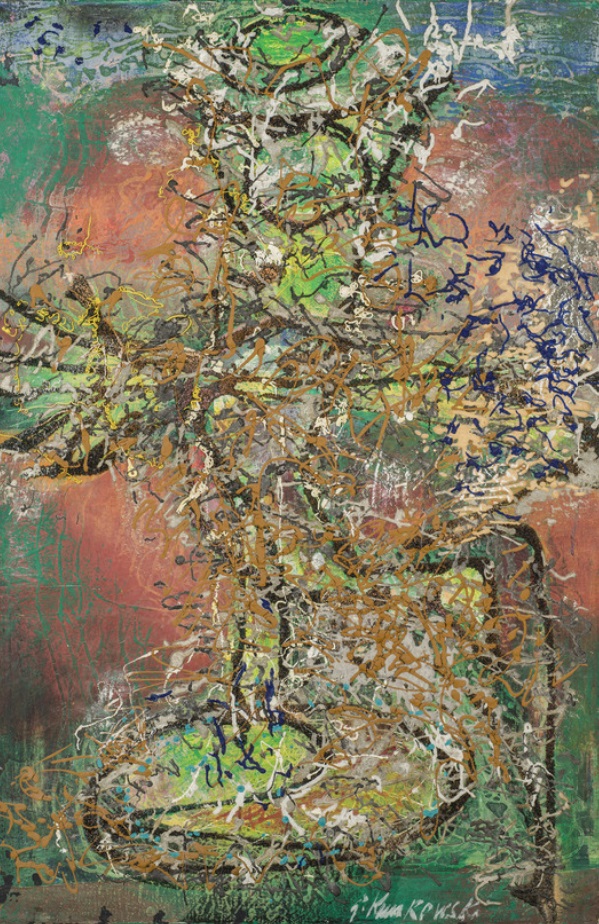
Gerome Kamrowski - Abstract Surrealism


 Gerome Kamrowski (1914 –2004) was an American artist and participant in the Surrealist Movement in the United States.He was born in Warren, Minnesota and begun to study art in the early 1930s at the St. Paul School of Art , and later to the New Bauhaus in Chicago (now Illinois Institute of Technology's Institute of Design). He then moved to New York to study with Hans Hofmann, where he was awarded a Guggenheim fellowship.In the late 1930s and early 1940s he lived in New York and had been working with surrealist automatism for several years. Kamrowski became an integral part of the emerging surrealists and collaborated with William Baziotes, Robert Motherwell, Jackson Pollock and Roberto Matta. This group was the kernel of the open-ended movement that was referred to as abstract surrealism and would over time prove to be the beginnings of abstract expressionism.Gerome Kamrowski was one of the few American artists to be included in Peggy Guggenheim's The Art of This Century Gallery in 1943. He also had shows at Museum of Modern Art in New York 1951, Hirshhorn Museum and Sculpture Garden, and at the Whitney Museum of Modern Art at several occasions. His work can also be seen in the Joe Louis Arena station of the Detroit People Mover . He showed his work in the 1947 International Surrealist Exhibition in Paris. He was invited to the Paris exhibition by surrealist leader André Breton. Breton would say of him, "Gerome Kamrowski is the one who has impressed me the most by reason of the quality and sustained character of his research."In 1948 he moved to Ann Arbor, Michigan to teach at the University of Michigan School of Art. He stayed at the University of Michigan until his retirement 1982. Very few of his students over the next fifty years realized that their teacher was one of the most important artists in America. Gerome Kamrowski worked every single day at his art. He created massive domes of oil on canvas and brought strange, beaded animals to life. His work balances fluid automatism with powerful abstract imagery. The many layers of paint created a visual maze that clearly communicates an intuitive language with the viewer.Wikipedia


Don P. Olsen - Abstract Expressionism


 Don P. Olsen /1910 -1983/
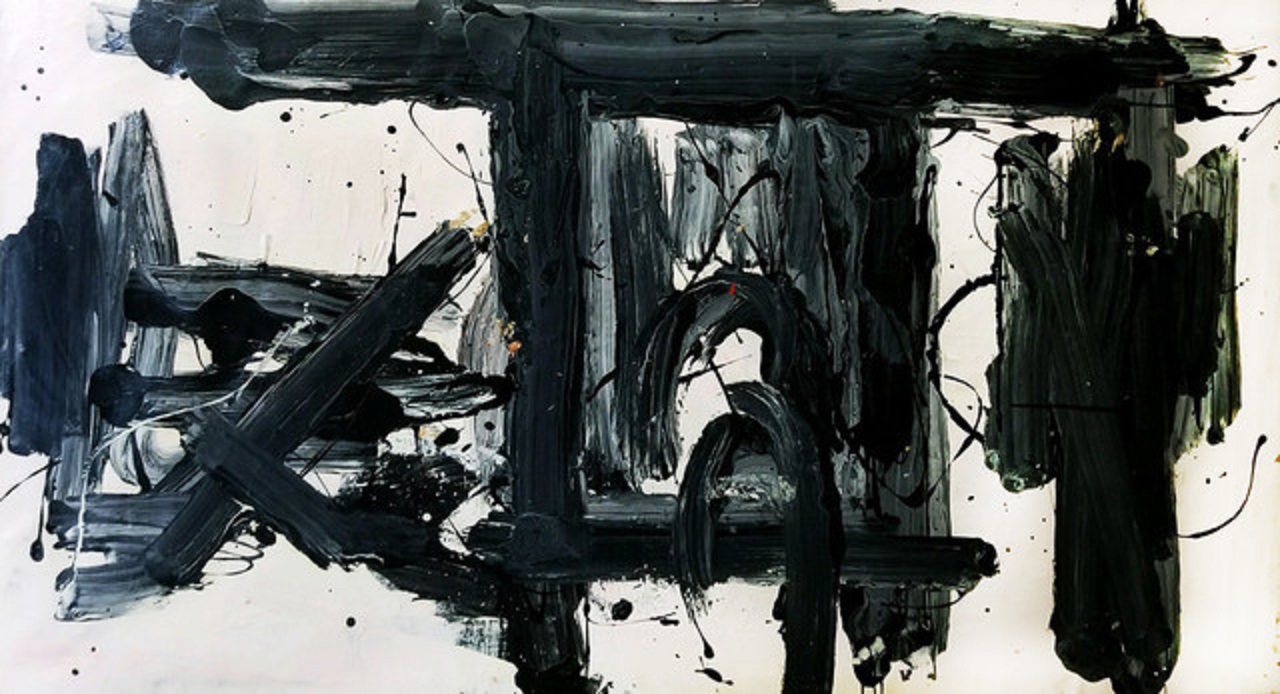
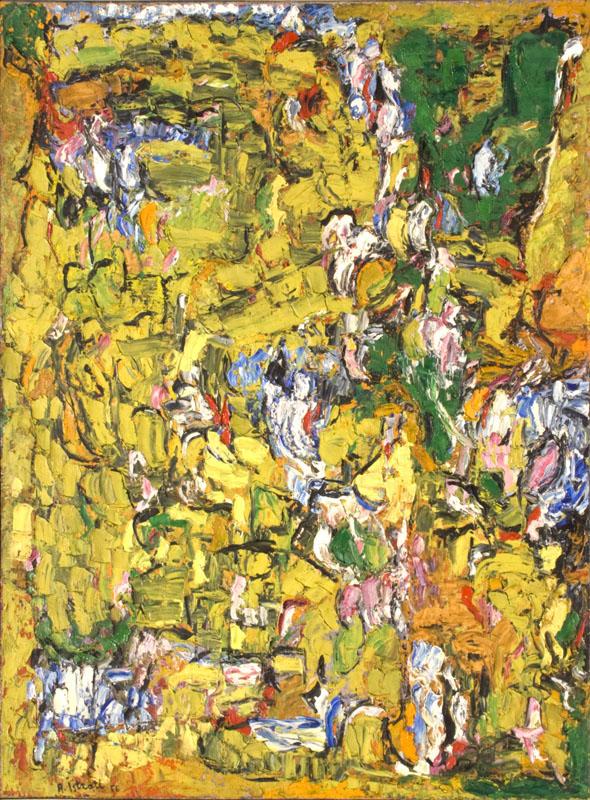
Don Penrod Olsen was born in 1910 and died in Utah 1983.  He made Utah his home.  Don was one of the most significant artists of Utah to emerge with more of a direct line with radical modernism.  He was an art teacher at Jordan High School and the Art Barn, which later became the Salt Lake Art Center.  Olsen wanted to meld the Utah School with national directions of abstract expressionism in art.
He bridged the early and later Utah generations of modernism most effectively.  Don worked through many of the abstract languages of art more brutally, from “BRUSHED-ACTION PAINTING” (abstract expressionism) to “HARD- EDGE” (minimalism).  He fell in between the lines of Gothic abstract painting.  He understood the intent of abstract expression better than anyother Utahn.
Olsen’s style became freer after he studied the summer of 1954 at Hans Hofmanns School of Art in Provincetown, Massachusetts.  In 1955, he exhibited at the Salt Lake Art Center with a one-man show developed from his recent study with Hofmann.  For a decade more, her would be known solely for his “large thickly painted-with-muscle brushwork”, or “brush-action-painting”.  
With his painting, Don reached an immediacy, involvement, and energy level seldom attained by his Utah peers.  It is an explosively vital work which attacks the viewer’s sensitivities with internal expressiveness.  His work protests the niceties of his colleagues and escapes to art of a different nature at its most ferocious.  In Olsens words: “Painting is not and illusion.  A painting can only be itself; it does not simulate, borrow from, or pretend to be anything outside itself.  It is a real thing and its reality lies in being itself.  A painting reveals the internal expression of the artist and has nothing to do with observation of visual facts”.(daviddeefinearts.com)


Richard Dick Wray - Abstract Expressionism Artworks


Richard Dick Wray (1933 - 2011) was an American abstract expressionist painter whose work had an influence on the art scene in Houston, Texas. After an art career spanning over 50 years, he died at age 77 of liver disease. His work continues to be showcased by art institutions and organizations across Houston, including the William Reaves Gallery, and is listed on the official website for the National Gallery of Art.
In 1955, Wray received an honorable discharge from the Army and enrolled in the School of Architecture of the University of Houston. There, he would spend the next 3 years studying various forms of architecture, until leaving the school to finish his studies at the Kunstakademie Düsseldorf, the Arts Academy of the city of Düsseldorf, Germany. Wray travelled to Europe in 1958 in order to discover what he believed was the "center" of the art world. The two years he spent in Europe—beginning in Paris and concluding in Germany—laid the foundation for his painting career. Though originally interested in architecture, Wray's interactions with the work of abstract expressionists, artists of a European avant-garde movement known as the CoBrA group and New York Abstract Expressionists (which Wray also saw for the first time in Europe) had tremendous influences on his artistic passions. In effect, Wray deviated away from architecture and, equipped with new knowledge of European expressionism, returned to Texas at age 26 to begin his career as a painter.Wikipedia