Exposition Art Blog: south african artist
Showing posts with label south african artist. Show all posts

Edoardo Daniele Villa


Edoardo Daniele Villa (1915–2011) was a notable South African sculptor of Italian descent who worked primarily in steel, and bronze
Villa's sculpture developed further during the 1950s, when the use of cut steel and bronze. At this time he also taught at the Polly Art Centre in Johannesburg. The Polly Art Centre was founded as an adult education institution; in 1952 it was converted into an art and exhibition centre. Until its closure in 1960, it was the only place – apart from a few private galleries – where black artists in Johannesburg could pursue their art and show their works.
Villa's work includes larger than life steel installations, such as Reclining Figure in Pieter Roos Park, Johannesburg. This work was intended as a play statue for children, paid for by Anglo American, selected by the Parktown and Westcliffe Heritage Trust and donated to the City of Johannesburg and unveiled by the Deputy Mayor of Johannesburg Councillor C.E. Fabel on 8 September 1984.Edoardo Villa represented South Africa at the Venice Biennale on five occasions and he has received awards at the São Paulo Biennales of 1957 and 1959.From his conventional heads and figures of the 1940s, Villa moved progressively through stylized figuration to structural abstraction. The universality of humankind is a theme that dominates his work.


https://milenaolesinska.blogspot.com/p/blog-page_50.html

Denis Bowen - Tachisme and Art Informel


Denis Bowen (1921 - 2006) was a South African artist, gallery director and promoter of abstract and avant-garde art in Britain. He was founder of the New Vision Group and the New Vision Centre Gallery, both of which played an important role in the post-World War II British art scene.Denis Bowen was born on 5 April 1921 in Kimberley, South Africa. His father was Welsh and his mother English. After being orphaned at a young age, Bowen moved to England where he was raised by his aunt in Huddersfield. He enrolled at the Huddersfield School of Art in 1936. After serving in the Navy in World War II, Bowen resumed his art studies at the Royal College of Art in London in 1946.Between 1940 and 1986 Bowen taught art at numerous institutions including: the Kingston Institute of Art, Hammersmith School of Art, Birmingham School of Art, the Central School of Art and Design, the Royal College of Art and the University of British Columbia in Vancouver.In 1951 Bowen founded the New Vision Group, which initially emerged from meetings and displays that he organised with his students in 1951. In 1955, Bowen worked alongside Frank Avray Wilson and Halima Nalecz to open a permanent exhibition space for the New Vision Group and associated artists. Bowen, Wilson and Nalecz were all members of the New Vision Group and also the Free Painters Group (later Free Painters and Sculptors) which had been founded a few years earlier.In the early years of his artistic career, from the early 1950s to the mid 1960s, Bowen formed part of a small group of UK-based artists who were associated with Tachisme and Art Informel. Between 1969 and 1980 he produced a series of "psychedelic works" that incorporated lighting effects (including the use of UV lights), music and live music performances. From the 1980s onward, Bowen's work developed cosmological and planetary themes.Wikipedia


Isaac Witkin - New Generation of sculptors


"Isaac Witkin (American, 1936–2006), Succoth, 1975. Steel. Gift of Jacques and Donatella Lennon, 91.2.1 | Isaac Witkin rejected the idea that the human figure is necessary to sculpture, and instead explored abstraction in his work. The sculpture consists of welded steel plates painted bright orange. Each plate has an irregular geometric shape, some straight and rigid and others elegantly curved. The sheets slice into one another, delicately balancing on precise contact points. Their sharp edges pierce the space around them, as if Witkin is not only carving the sculpture but also carving air. The overlapped and stacked forms allow for a constantly changing play of light and shadow, assuming different configurations based on the viewing angle. Witkin had a consistent interest in how the scale of a sculpture can be determined by its relationship to the human body. He once stated that “I aim to establish a freedom to move in multiaxial space in a way that draws the spectator in and around the sculpture to experience different aspects of an evolving dynamic.”(wcma.williams.edu)


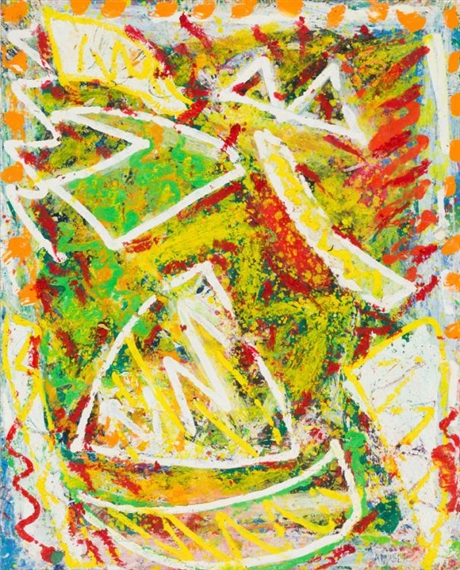
Bill Ainslie - Abstract Expressionism - South Africa

William “Bill” Ainslie was a South African artist, teacher, activist, as well as and the founder of several art projects. Ainslie was born on 10 April 1934 in Bedford, Eastern Cape, where his family farmed a parcel of land called Spring Grove”. His family moved to the Karoo when he was a young boy but subsequently left for Johannesburg because of a drought. His father died when he was eight years old.
Ainslie had intended to become a priest, until art claimed his imagination when he was a student. He studied at the University of Natal, Pietermaritzburg from 1952-1955. In 1958, he completed his honours degree in Fine Art. On completion of his studies he taught at Michael house, a school in KwaZulu Natal. He also taught art at Cyrene Mission in Zimbabwe and King Edward VII School in Johannesburg, his alma mater In 1960, Bill married Sophia Jansen-Schottell (known as Fieka). He died in a car accident in August 1989 returning from an international workshop at the Cyrene Mission in Zimbabwe.Ainslie’s paintings transitioned from monumental African figures featuring mothers and children, and farm labourers to abstract expressionism. He was renowned for his use of striking and vibrant colours His painting found connections with American abstract expressionism and as a result, Ainslie tended to teach abstraction.Wikipedia