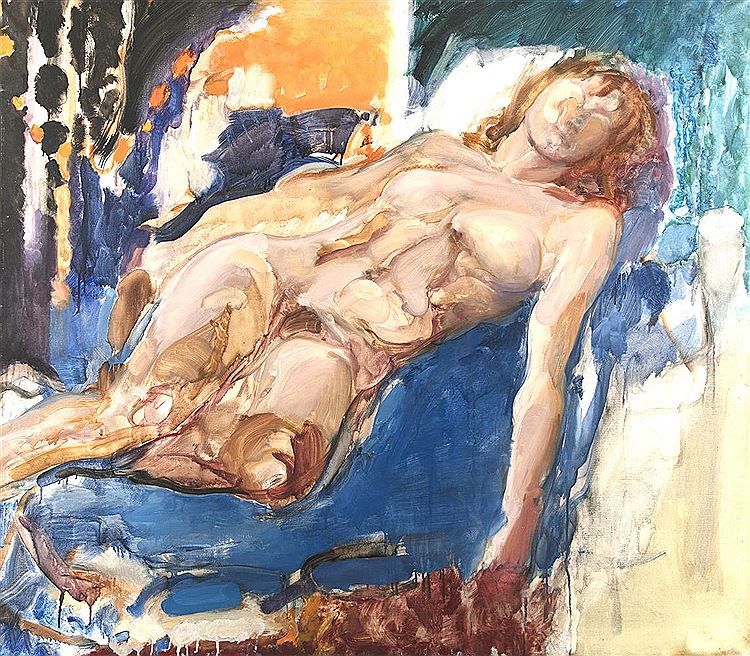
New works by a Swedish artist


Painting is like silent poem, said Simonides, poet from ancient Greece.Paintings are icons, doors to the Platonian world above the heavens. Paintings on my blog are just those icons, which lead a viewer into the magic world of harmony and beauty. Artists who present their achievements on my blog have a very different cultural and national background, they represent variety of artistic traditions and schools

Jerzy Wladyslaw Puciata (1933 - 2014) - Polish painter
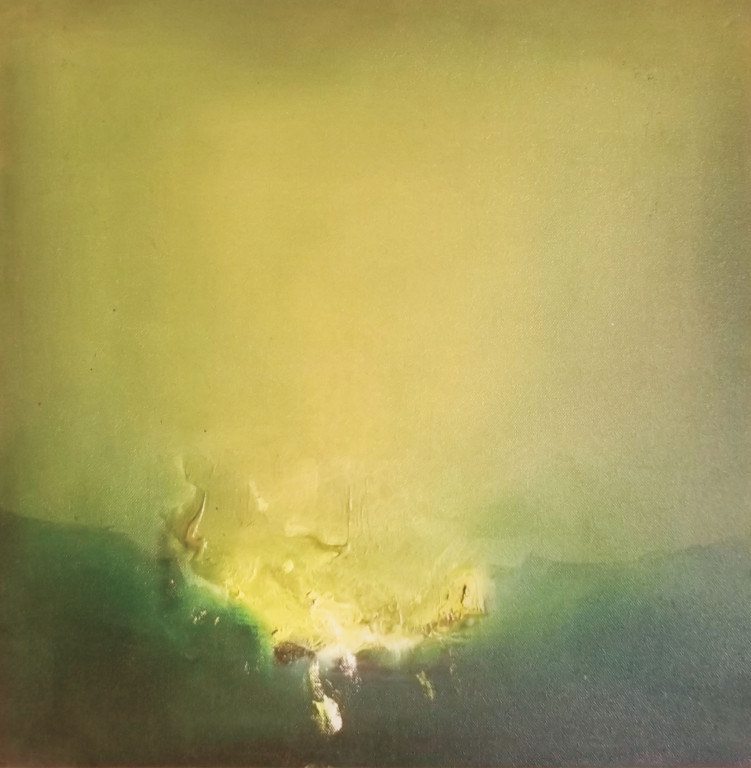
“Light is life. Light is God. (…) Light tears up darkness and gives hope. (...) light is the pursuit of deeper knowledge, perfection. It is an expression of my hope that I want to share. It is also the joy of life - the light of colors. These are memories of the moments I experienced, colors, words, all nature. The atmosphere of specific places.
My imagination allows me to go beyond the box. The image must radiate something special, unique, provoking reflection and contemplation. "




Jean Fautrier (1898 –1964) was a French painter, illustrator, printmaker, and sculptor. He
was one of the most important practitioners of Tachisme.Jean Fautrier
was born in Paris in 1898. He was given his unwed mother's surname and
raised by his grandmother until she and his father both died in 1908. He
then moved to London to be with his mother. There, in 1912, he began to
study at the Royal Academy of Arts. Unsatisfied by instruction he
thought too rigid, he left to study briefly at the Slade School, which
was reputed to be more avant-garde. He was disappointed again and
decided to go it alone, devoting himself to painting. The works he saw
in the Tate Gallery made a far greater impression on him; he especially
admired the paintings of J. M. W. Turner. He was called up for the
French Army in 1917, but was discharged in 1921 due to his poor health. He first exhibited his paintings at the
Salon d'Automne in 1922 and at the Fabre Gallery in 1923. It was at the
Galerie Fabre that he met art dealer Jeanne Castel, his first collector
and friend. In 1923 he began producing etchings and engravings. His
first solo exhibition was at the Galerie Visconti in Paris, in 1924.
In
1927, he painted a series of pictures (still lifes, nudes, landscapes)
in which black dominates. In 1928 he met André Malraux through Castel.
Malraux asked Fautrier to illustrate a text of his choice, but copyright
issues kept him from using his first choice, Arthur Rimbaud’s ‘’Les
Illuminations’’, and he settled instead with Dante’s Inferno. He
produced 34 lithographs, but the publication, proposed by Gallimard, was
deemed impossible and the project was abandoned in 1930. Until 1933 he
divided his efforts between sculpture and painting. Short on funds, he
spent the years 1934–1936 living in the resort of Tignes, where he made
his living as a ski instructor and started a jazz club.In 1939, just as World War II was
beginning, Fautrier left the mountains, moving to Marseille,
Aix-en-Provence, and Bordeaux before finally returning to Paris in 1940
and starting to paint once again. In Paris he met several poets and
writers for whom he created illustrations. In January 1943, he was
arrested by the German Gestapo. After brief imprisonment, he fled Paris
and found refuge in Châtenay-Malabry, where he began work on the project
of the Otages (or "Hostages"). These paintings were a response to the
torture and execution of French citizens by the Nazis outside his
residence, and were exhibited in 1945 with the Drouin gallery. In the
years that followed, Fautrier worked on the illustrations of several
works, among them L'Alleluiah by Georges Bataille, and made a series of
paintings devoted to small familiar objects.
His late work is
abstract, generally small in scale, often combining mixed media on
paper. In 1960 he won the international grand prize at the Venice
Biennale as well as another major award at the Tokyo Biennale the
following year. He died in Châtenay-Malabry in 1964, the same year in
which he had made donations to the Musée de l’Ile-de-France in Sceaux
and Musée d’Art Moderne de la Ville de Paris. A retrospective of his
work opened there later that year. and was organized by the Gianadda
Foundation at Martigny in January–March 2005.Wikipedia


Barrie Cooke (1931 - 2014) is widely considered one of our leading contemporary artists. He was born in Cheshire in 1924, but lived in Ireland since 1954 until his death in 2014. Brought up in Jamaica and Bermuda, Cooke moved to the US as a teenager and studied art history and biology at Harvard University. He was a major figure in the development of painting in Ireland, an environment which he found offered him fertile ground for his lifelong love of nature, and his twin passions of painting and fishing. Cooke travelled extensively. His journeys to Lapland, Cuba, Cape Cod, Mexico, New Zealand, Russia, and Madeira are viscerally depicted in his work. The formation, transformation and degradation of the environment have been constant motifs. Hugely respected by his peers for the commitment and integrity of his vision, Cooke had his first solo exhibition in Dublin in 1955 and the following year received a scholarship to study with Oskar Kokoschka in Salzburg. He developed deep friendships with several poets including the late Séamus Heaney, John Montague and Ted Hughes. He represented Ireland at the Paris Biennale in 1963 and exhibited widely throughout Europe, the US and Canada. Major retrospectives include shows in the Douglas Hyde Gallery (1986), the Haags Gemeentemuseum, The Hague (1992), and LAC, Perpignan, France (1995). His work is held by IMMA, the Ulster Museum, the Stedelijk Museum, Amsterdam, the Haags Gemeentemuseum, and in many other collections worldwide.(oliversearsgallery.com)