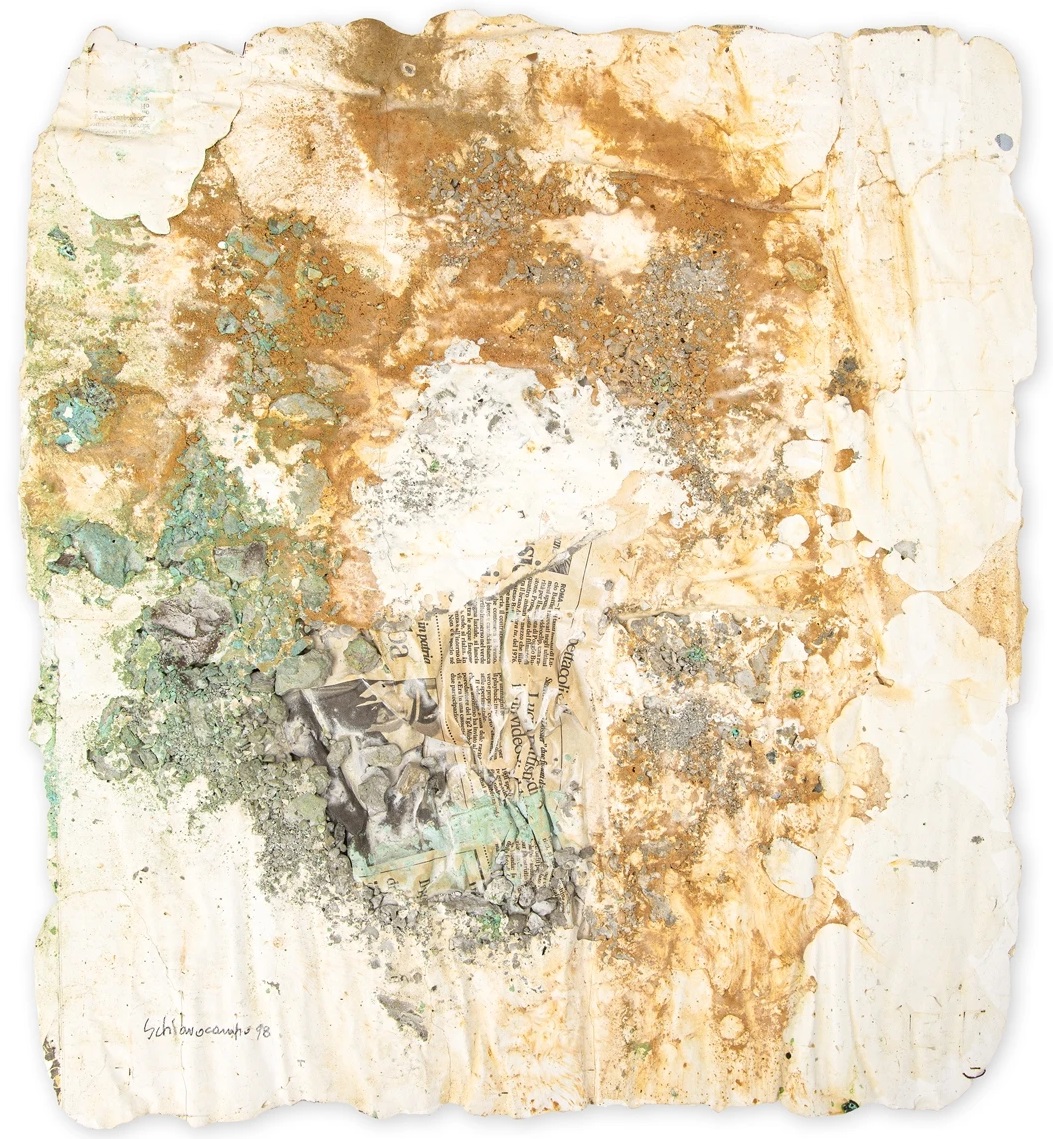
Emilio Scanavino (Genoa, 28 February 1922 – Milan, 28 November 1986) was an Italian painter and sculptor.In 1938 the young Scanavino enrolled to the Art School Nicolò Barabino of Genoa where he met his teacher Mario Calonghi, who had a great influence on Scanavino’s first formation. In 1942 he had his first exhibition at the Salone Romano of Genoa. In the same year he enrolled at the Faculty of Architecture at Milan University. In 1946 he married Giorgina Graglia.


In 1947 Scanavino moved, for the first time, to Paris where he met poets and artists such as Edouard Jaguer, Wols and Camille Bryen. This experience results invaluable on his stylistic grown. He especially assimilated Cubism echoes which he rendered into a personal interpretation since 1948 when he exhibited at the Gallery Isola of Genoa. In the '50 years He was part of the Group "I sette del Numero" of the Numero Gallery in Florence, together the other famous painter Rocco Borella. In 1950 he exhibited at the 25th edition of the Venice Biennale and in 1951 at the Apollinaire Gallery of London in a two-person exhibition with the sculptor Sarah Jackson.


After a figurative start Scanavino's paintings rapidly took Post-Cubist character. Stylization of the forms kept growing until eventually totally fade out in the first 1950 years works. In 1954 his work's characteristic sign started to appear. That is the “stylized knot”, which would characterize all of his following production. The 1950s years works are among the most beautiful of Scanavino's career. Inside them it is possible to see the genesis of the painting transposition of the interiority, with all of its torment, which are the marking point of Scanavino's art.
In his late 1970s years paintings, the “knot” is perfectly defined and recognizable. Painted in anguishing forms, sometimes even threatening and stained of bloody red. Although Scanavino is difficult to place inside a defined artistic movement, he can be considered[by whom?] an informal abstractist, close to the Abstract Expressionism and Hans Hartung and Georges Mathieu's art.Wikipedia