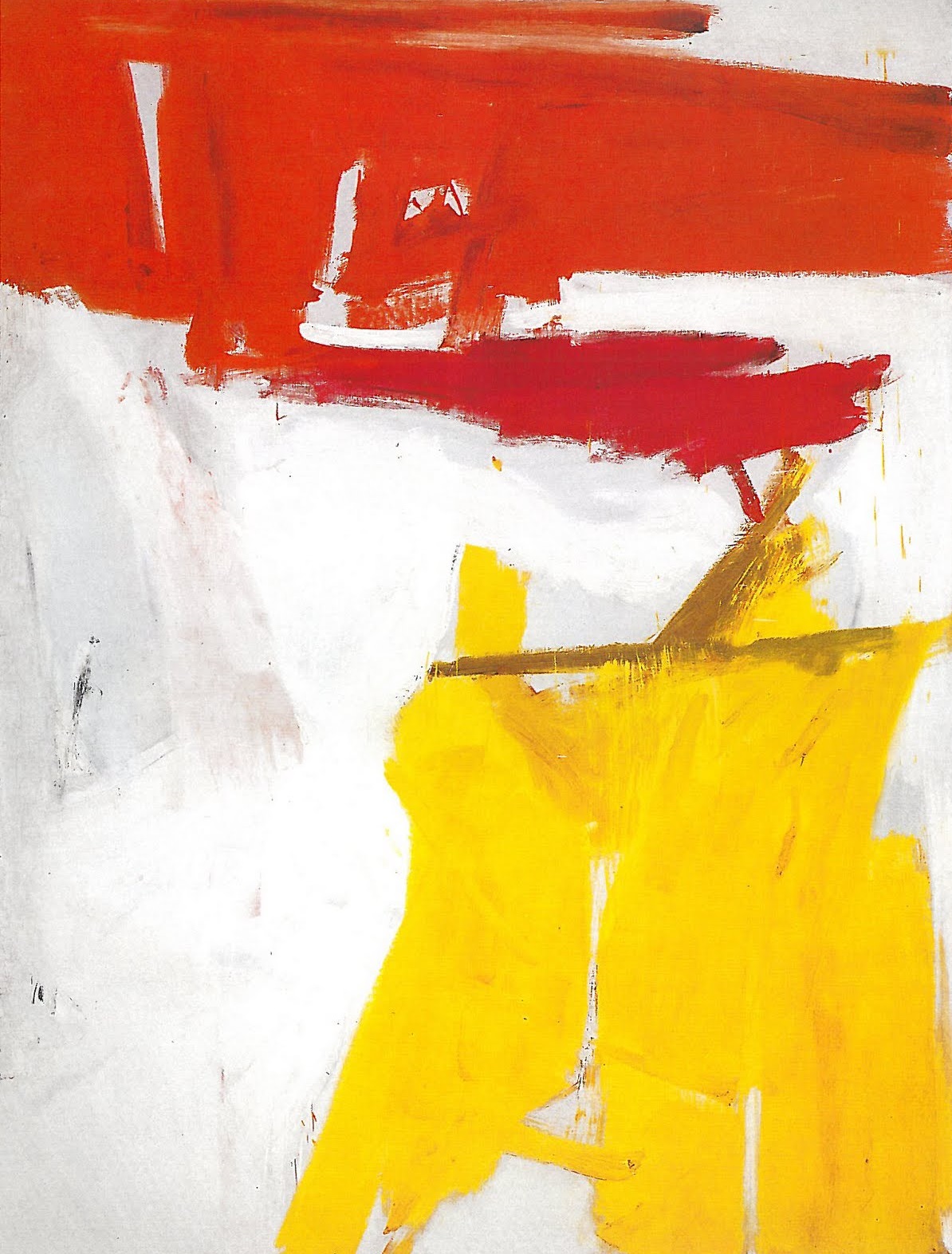
Exposition Art Blog: Franz Kline
Showing posts with label Franz Kline. Show all posts

Franz Kline - Abstract Expressionist and Action Painting

Franz Kline was born on May 23, 1910, in Wilkes-Barre, Pennsylvania. He studied painting and drawing at Boston University (1931–35), and drafting and illustration at the Heatherley School of Fine Art, London (1937–38). After returning to the United States, he settled in New York, where he produced traditional cityscapes and interior scenes and, in the early 1940s, won awards at several National Academy of Design Annuals.Kline soon began experimenting with small black-and-white brush drawings after Willem de Kooning introduced him to abstraction. At the end of the decade, De Kooning’s use of a Bell-Opticon projector inspired Kline to project his brush drawings onto his studio wall, transforming them into large-scale ideograms. These experiments marked the beginning of Kline’s characteristic abstractions incorporating powerful lines and rapidly developed gestures of black paint on white ground. Compositions such as Wotan (1950–51) prompted speculation about the influence of East Asian calligraphy on Kline’s practice; he denied these claims, stating that he fully intended the images to evoke the known or recognizable while avoiding literal references. Kline employed intense tonal contrasts, often working at night under strong light. His use of housepainters’ brushes produced tiny splatters and inflections on the canvas that enhanced the explosive quality of his black lines.(guggenheim.org)


Action Painting Franz Kline

Franz Kline (May 23, 1910 – May 13, 1962) was an American painter. He is associated with the Abstract Expressionist movement of the 1940s and 1950s. Kline, along with other action painters like Jackson Pollock, Willem de Kooning, Robert Motherwell and Lee Krasner, as well as local poets, dancers, and musicians came to be known as the informal group, the New York School. Although he explored the same innovations to painting as the other artists in this group, Kline's work is distinct in itself and has been revered since the 1950s
"Franz Kline's life story reads like a movie plot: Young artist starts out with high hopes, spends years struggling without success, eventually finds a style, becomes an "overnight sensation" and dies too soon.Kline was best known for his role as an "action painter" of abstract expressionism, a movement that was popular in New York during the 1940s and 1950s and introduced the world to artists including Jackson Pollock and Willem de Kooning.Kline was born on May 23, 1910 Wilkes-Barre, Pennsylvania. As the cartoonist for his high school newspaper, Kline was a good enough student to leave coal-mining country and attend Boston University. With budding artistic ambition, he went  to study at the Art Students League, and then Heatherly Art School in London. In 1938, he returned to the U.S. with his British wife and settled in New York City.It seemed New York really didn't care much that Kline had talent back in England and was ready to take on the world. He struggled for years as a figurative artist, doing portraits for two loyal patrons that won him a modest reputation. He also painted city scenes and landscapes, and occasionally resorted to painting barroom murals to pay the rent money.In the mid 1940s, he met de Kooning and Pollock, and began to explore his own growing interest in trying new styles of painting.Kline had been noodling around with black and white for years, creating small brush drawings and projecting them onto the wall of his studio. Now he got rather serious about creating the projected images using just his arm, brush and mental imagery. The pictures that began to emerge were given a solo exhibition in New York in 1950.As a result of the show, Franz became an established name in the art world and his large, black and white compositions—likened to grids, or Oriental calligraphy—achieved notoriety.With his reputation as a leading abstract expressionist secured, Kline concentrated on turning out his new passion. His new work had short, seemingly meaningless names, such as Painting (sometimes followed by a number), New York, Rust or the old stand-by Untitled.He spent his last years trying to introduce color back into the mix, but was cut down in his prime by heart failure. Kline died on May 13, 1962 in New York City. He couldn't explain what his paintings meant, but Kline left the art world with the understanding that explanation of his art was not its intended purpose. His paintings were supposed to make one feel, not comprehend."(Shelley Esaak  thoughtco.com )


Action painting Franz Kline

Franz Kline (May 23, 1910 – May 13, 1962) was an American painter born in Pennsylvania. He is mainly associated with the Abstract Expressionist movement of the 1940s and 1950s. Kline, along with other action painters like Jackson Pollock, Willem de Kooning, Robert Motherwell and Lee Krasner, as well as local poets, dancers, and musicians came to be known as the informal group, the New York School. Although he explored the same innovations to painting as the other artists in this group, Kline's work is distinct in itself and has been revered since the 1950s.
Kline is recognized as one of the most important yet problematic artists of the Abstract Expressionist movement in New York. His style is difficult for critics to interpret in relation to his contemporaries.[14] As with Jackson Pollock, Willem de Kooning, and other Abstract Expressionists, Kline was said to be an action painter because of his seemingly spontaneous and intense style, focusing not at all on figures or imagery, but on the expression of his brushstrokes and use of canvas.[citation needed] However, Kline's paintings are deceptively subtle. While generally his paintings have a spontaneous, and dramatic impact, Kline often closely referred to his compositional drawings. Kline carefully rendered many of his most complex pictures from extensive studies, commonly created on refuse telephone book pages. Unlike his fellow Abstract Expressionists, Kline's works were only meant to look like they were done in a moment of inspiration; however, each painting was extensively explored before his housepainter's brush touched the canvas.
Kline was also known for avoiding giving meaning to his paintings, unlike his colleagues who would give mystical descriptions of their works.In a catalog of Kline's works, art historian Carolyn Christov-Bakargiev writes that "his art both suggests and denies significance and meaning."Many of his works have been viewed by art historians as indications of a progression towards minimalist painting. They believe that his works hold an objective opacity and frankness that differs from the subjectivity involved with the New York School's style. This would make his work more similar to the avant-garde platforms like minimalism that replaced the Abstract Expressionist movement in the 1960s.Art historian David Anfam notes that artists working during Kline's life and after—such as Robert Rauschenberg, Cy Twombly, Mark di Suvero, and Brice Marden—have all called Kline an inspiration.Wikipedia