Exposition Art Blog: Belgian sculptor
Showing posts with label Belgian sculptor. Show all posts

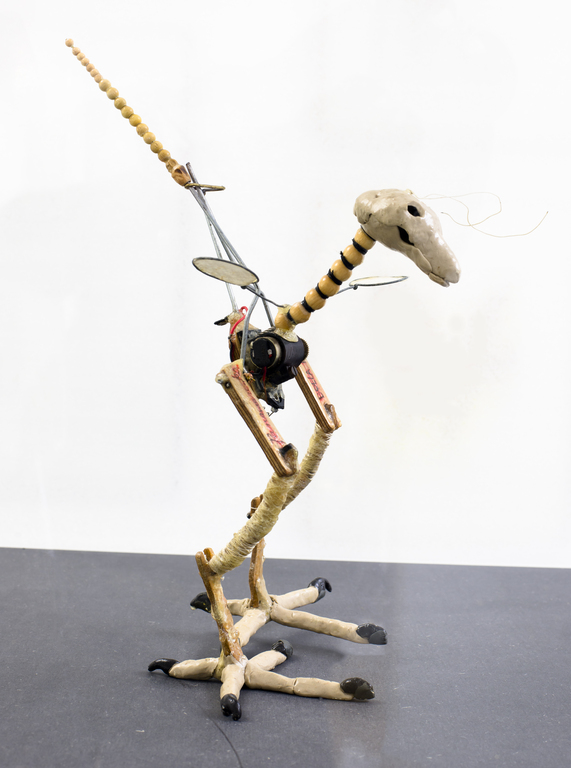
Panamarenko


Henri Van Herwegen (1940 – 2019), known by the pseudonym Panamarenko, was a prominent assemblagist Belgian sculptor. Famous for his work with aeroplanes as theme; none of which are able nor constructed to actually leave the ground.
Panamarenko was born in Antwerp, where he studied at the Royal Academy of Fine Arts from 1955 to 1960. Before 1968, his art was inspired by pop-art, but early on he became interested in aeroplanes and human powered flight. Starting in 1970, he developed his first models of imaginary vehicles, aeroplanes, balloons or helicopters, in original and surprising appearances. Many of his sculptures are modern variants of the myth of Icarus. The question of whether his creations can actually fly is part of their mystery and appeal. 


https://milenaolesinska.blogspot.com/p/blog-page_50.html

George Grard

George Grard (1901-1984) was a Belgian sculptor, known above all for his representations of the female, in the manner of Pierre Renoir and Aristide Maillol, modelled in clay or plaster, and cast in bronze.
Grard was born in Tournai to a family of modest means and entered the Académie de Tournai in 1915, but his real calling as a sculptor became apparent when he followed a course in sculpture in 1922 with Maurice De Korte (1889–1971). In his native city he met Pierre Caille, and later, in a Brussels foundry, Charles Leplae. Having won the Prix Rubens (1930), he left for Paris, where he encountered the sculpture of Charles Despiau, Aristide Maillol and Pierre Renoir, which influenced his mature style. In 1931, he set up his studio at Saint-Idesbald on the coast, where his house became a rendez-vous of artists including Pierre Caille, the Haesaerts brothers, Edgard Tytgat and Paul Delvaux.In 1935, he was commissioned to create a sculpture for the rose garden at the Exposition universelle et internationale. Two years later Henry Van de Velde asked him for a work for the Belgian pavilion of the Exposition internationale, 1937. In the nineteen-fifties Grard, still in full possession of his mature powers, received repeated public commissions: the Seated Figure at the Banque Nationale, Brussels (1950), La Mer, fronting the post office at Ostend (1955, illustration), the Naïade at Tournai (1950), and Earth and Water, near the Albert Bridge at Liège (1964).George Grard died in Saint-Idesbald in 1984.Wikipedia


Belgian kinetic artist Pol Bury

Belgian kinetic artist, painter and film-maker, born in Haine-Saint-Pierre. After studying briefly at the Academie des Beaux-Arts in Mons 1938-9, he frequented the circle of Surrealist poets at La Louvière and was influenced by the paintings of Magritte and Tanguy. His own painting largely interrupted from 1940 to 1945. Represented in the Exposition Internationale du Surréalisme in Brussels 1945. Painted geometrical abstract pictures 1949-53 and was associated with the COBRA group 1949-51, but in 1953 started to make 'plans mobiles' of painted shapes which could be pivoted manually on their axis. First principal one-man exhibition at the Galerie Apollo, Brussels, 1953. Gave up painting in 1953 and experimented with various types of kinetic works, introducing motors in 1957 and making the parts move with an almost imperceptible but jerky slowness, and in a random way. Moved to France in 1961 (first Fontenay-aux-Roses, then Saulx-les-Chartreux), and since 1964 has frequently visited the USA. His later works also include cinetizations of photographs and engravings, a few large-scale sculptures such as '25 Tons of Columns' and several films. Lives in Paris.(.tate.org.uk)