Danila Vassilieff (16 December 1897 – 22 March 1958) was a Russian-born Australian painter and sculptor. He has been called the "father of Australian modernism.
Danila Ivanovich Vassilieff was born in 1897 at Kagalnitskaya, near Rostov-on-Don, Russia. His father was a Cossack and his mother Ukrainian. He studied mechanical engineering at a technical school at Novocherkassk and at a military academy in Saint Petersburg. During World War I and the Russian Civil War, he served with a Don Cossack cavalry regiment. He was captured by the Red Army at Baku in April 1920, but escaped by motorbike and made his way to China via Armenia, Persia, India and Burma.In May 1923 in Shanghai he married Anisia Nicolaevna, a fellow refugee; then they set out for Australia, arriving in Townsville, Queensland in July.They bought a sugar-farm at Yuruga, located near Ingham. By 1928 he was working as a railway labourer at Mataranka, Northern Territory. It was here that he began to paint, using a child's paint set. In 1929 he separated from his wife, was naturalized, and left Australia. He travelled to Paris and then on to Rio de Janeiro, Brazil, where in 1930 and 1931 he had his first formal studies in art, under Dimitri Ismailovitch, a specialist in Byzantine mosaics and frescoes. From 1932 to 1935 he worked and exhibited in the West Indies, South America, England, Spain and Portugal.


While living in England, his ideas of using traditional Russian decorative art in a modernist context began to form. This was helped by his friendship with Vladimir Polunin, at that time a teacher at the Slade School of Fine Art but previously a scene painter for Sergei Diaghilev's Ballets Russes. Danila Vassilieff wanted to return to Russia, but Stalin's repressive regime made this impossible.In 1935, when he decided to return from England to Australia, he stored over 50 paintings with his friends the Ogilvies near Bristol: by the outbreak of WWII in 1939 they were in the Ogilvies' attic. With the risk of incendiary bombs, the authorities insisted that most should be burnt – a number were kept hanging in the Ogilvies' home.
n October 1935, he settled in Sydney. He painted inner-city street scenes, still lifes, portraits and landscapes, and exhibited twice at the Macquarie Galleries.


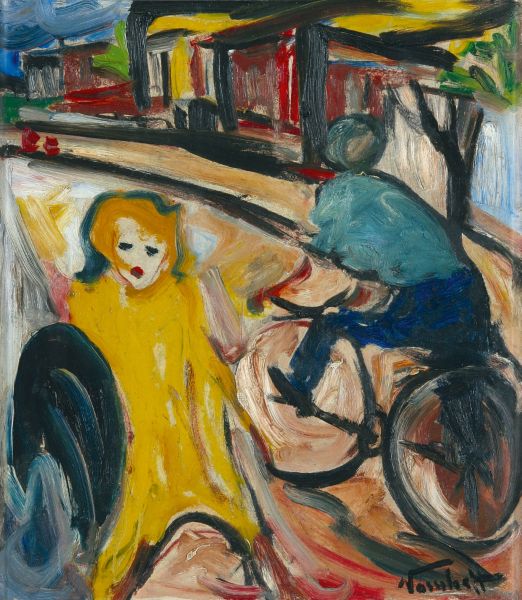
In 1937 he took up with Helen Macdonald, moving to Biloela, Queensland, and then to Melbourne, Victoria. Here his reputation gradually grew. His paintings were often of children playing in the streets of inner suburban Melbourne. Vassilieff mixed in Melbourne's local Russian émigré and artistic circles, and joined the Contemporary Art Society. He was befriended by people of the Heide Circle such as George Bell, Vance and Nettie Palmer, John and Sunday Reed, Arthur Boyd and John Perceval. His style began to influence younger artists such as Albert Tucker, Lina Bryans, Joy Hester, Charles Blackman and Sidney Nolan. This group of artists came to be known collectively as the Angry Penguins, and Vassilieff is now considered their father figure.


In 1939 he became foundation art teacher at the experimental Koornong School, Warrandyte, operated by Clive and Janet Nield. His lover Helen Macdonald was a music teacher there. Nearby, he built a house of stone and logs that he named "Stonygrad". This home became a focal point for the Angry Penguins and other local artists. His most supportive critic at that time was Basil Burdett, who was killed in an aircraft crash in 1942, soon after Germany invaded Russia.In 1944 his relationship with Helen Macdonald ended. He decided to sell Stonygrad and move to South Africa, but he fell in love with the purchaser, Elizabeth Orme Hamill, née Sutton, a 31-year-old lecturer and a divorcee. Following a belated divorce from his first wife Anisia, in 1947 he married Hamill.Around this time, sculpture began to figure prominently in his output. He quarried Lilydale marble himself, and used power tools for his rough work, but gave his pieces a brilliant finish. In 1953 he became vice-president of the Contemporary Art Society.[3] He and Elizabeth separated in 1954 and he went to Mildura High School as an art teacher, transferring to Swan Hill the following year. He was a keen fisherman and regularly shared this hobby with the Swan Hill High School principal, Fred Wells. He continued to exhibit at the Gallery of Contemporary Art, Melbourne, in 1956 and 1957, but his work was either not noticed or strongly criticised. He was transferred to Eltham by the Victorian Education Department, but was sacked for unsatisfactory performance. He returned to Mildura, living in a shack and painting watercolours.Wikipedia