Exposition Art Blog: op-art
Showing posts with label op-art. Show all posts

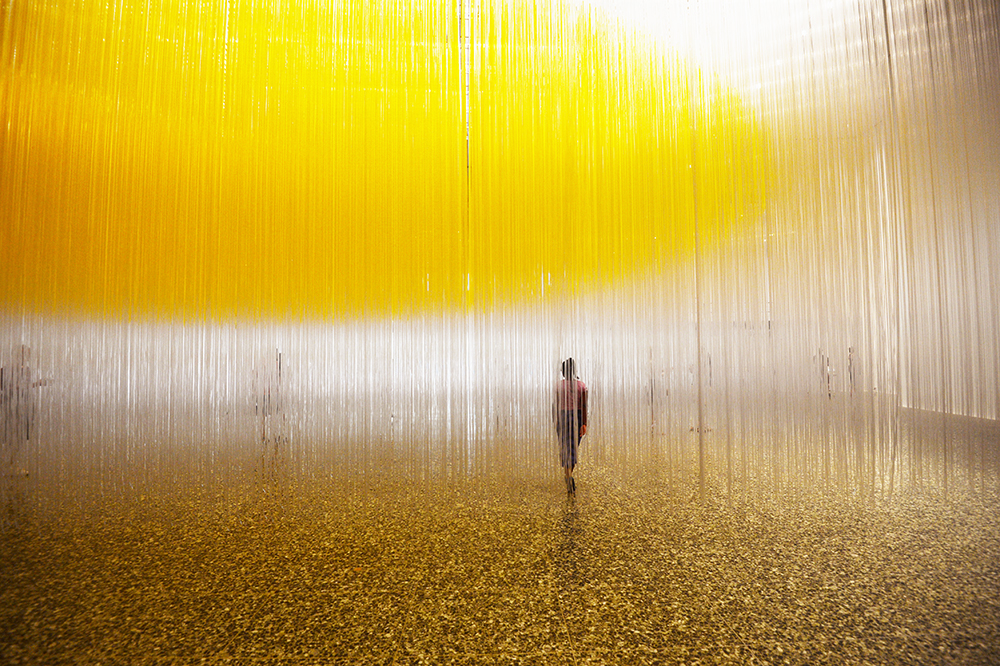
Jesus Rafael Soto

"Energy is one of the most striking elements of Soto's work and his experiments with optical effects are representative of some of the most successful of the Op Art-Kinetic Art movements. Soto's work, however, surpasses the mere exploitation of optical effects and he presents in his paintings a concentration of energy which attain a point where the paintings become a mirage, kinesthetically like a mental tension.Soto's use of the moire effect plays a prominent role in his early works of transition from the tradition of hard-edge abstraction founded by Modrian to the more fluid expression he presently uses. The influence of Modrian's balancing of lines and composition can be found in Soto's work, with Soto's added touch of a personal search for an art which would be its own master, wholly independent of the natural world, an attitude reflective of Modrian's.
Soto's work with identical and multipliable elements was aimed at reducing the sign to total anonymity, in the effort to get away from subjective art. When the transition to kinetic art came Soto's way in 1955 he began to make plexiglass superimpositions. Spirals traced upon perspex were superimposed in depth. The optical effect that resulted was in the relationship between the surfaces. Soto's painting began to emerge and assume a sculptural dimension when he suspended wire and rods of metal in front of the background. This striping of the background seems to create the effect of attacking and partly absorbing the forms which are placed in front of it. Soto's work established a concrete relationship with the viewers perception as disconcerting and fascinating as a mirage."(rogallery.com)




Op-Art Jean-Pierre Vasarely

Jean-Pierre Vasarely (1934–2002), professionally known as Yvaral, was a French artist working in the fields of op-art and kinetic art from 1954 onwards. He was the son of Victor Vasarely.
Yvaral studied graphic art and publicity at the École des Arts Appliqués in Paris between 1950 and 1953. In 1960, Yvaral co-founded the Groupe de Recherche d’Art Visual (GRAV) with Julio Le Parc, François Morellet, Francisco Sobrino, Horacio Garcia Rossi and Joel Stein, seeking to develop a coherent abstract visual language composed of simple geometric elements.
In 1975 he coined the phrase 'Numerical Art' to describe artwork composed (or programmed) according to numerical rules or algorithms. From this time onwards he used computers to digitally process and manipulate images, although the final images were always hand painted. He used this technique to produce several series of portraits starting from instantly recognisable images, such as the face of Marilyn Monroe, and processing them to the point where they become abstract compositions, while the original image remains recognisable.He died on August 2, 2002, aged 68.Wikipedia


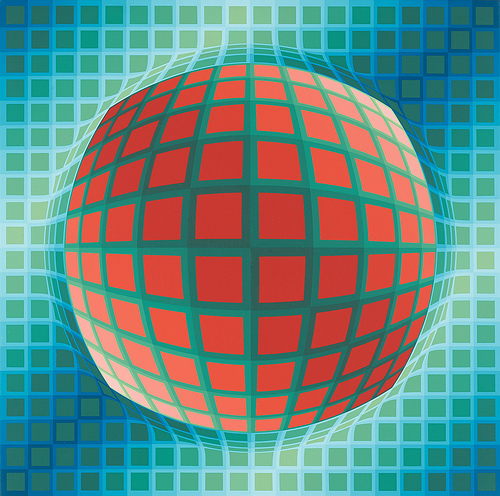
Op-art Victor Vasarely

Victor Vasarely (9 April 1906 – 15 March 1997), was a Hungarian–French artist, who is widely accepted as a "grandfather" and leader of the short-lived op art movement.
His work entitled Zebra, created in the 1930s, is considered by some to be one of the earliest examples of op art.
Vasarely was born in Pécs and grew up in Pöstyén (now Piešťany, Slovakia) and Budapest, where in 1925 he took up medical studies at Eötvös Loránd University. In 1927, he abandoned medicine to learn traditional academic painting at the private Podolini-Volkmann Academy. In 1928/1929, he enrolled at Sándor Bortnyik's private art school called Műhely (lit. "Workshop", in existence until 1938), then widely recognized as Budapest's centre of Bauhaus studies. Cash-strapped, the műhely could not offer all that the Bauhaus offered. Instead it concentrated on applied graphic art and typographical design.


 In 1929 he painted his Blue Study and Green Study. In 1930, he married his fellow student Claire Spinner (1908–1990). Together they had two sons, Andre and Jean-Pierre. In Budapest, he worked for a ball-bearings company in accounting and designing advertising posters. Vasarely became a graphic designer and a poster artist during the 1930s combining patterns and organic images with each other.


 Vasarely left Hungary and settled in Paris in 1930. He worked as a graphic artist and as a creative consultant at the advertising agencies Havas, Draeger and Devambez (1930–1935). His interactions with other artists during this time were limited. He thought of opening an institution modeled after Sándor Bortnyik's műhely and developed some teaching material for it. Having lived mostly in cheap hotels, he settled in 1942/1944 in Saint-Céré in the Lot département. After the Second World War, he opened an atelier in Arcueil, a suburb about 10 kilometers from the centre of Paris. In 1961, he finally settled in Annet-sur-Marne.
Vasarely eventually went on to produce art and sculpture using optical illusion. Over the next three decades, Vasarely developed his style of geometric abstract art, working in various materials but using a minimal number of forms and colours...He died age 90 in Paris on 15 March 1997.Wikipedia