Wilhelmina Barns-Graham (1912 –2004) was one of the foremost British abstract artists, a member of the influential Penwith Society of Arts.Through the course of her life Wilhelmina Barns-Graham's work generally lay on the divide between abstract and representational, typically drawing on inspirations from landscape. From as early as the age of eight Barns-Graham had been creating abstract shapes with coloured chalks. From 1940, when she arrived in Cornwall, her pictures are exploratory and even tentative as she began to develop her own method and visual language. The influence of St Ives then starts to arise, to take hold as local shapes and colours appear in the images - the Cornish rocks, landscape and buildings. Perhaps the most significant innovation at this time derived from the ideas of Naum Gabo, who was interested in the principle of stereometry - defining forms in terms of space rather than mass. Barns-Graham's series of glacier pictures that started in 1949, inspired by her walks on the Grindelwald Glacier in Switzerland, reflect the idea of looking at things in a total view, not only from the outside but from all points, including inside. In 1952 her studies of local forms became more planar and two dimensional, but from the mid-1950s she had developed a more expressionist and free form attitude following journeys to Spain.Wikipedia
Painting is like silent poem, said Simonides, poet from ancient Greece.Paintings are icons, doors to the Platonian world above the heavens. Paintings on my blog are just those icons, which lead a viewer into the magic world of harmony and beauty. Artists who present their achievements on my blog have a very different cultural and national background, they represent variety of artistic traditions and schools
Showing posts with label British abstract artist. Show all posts
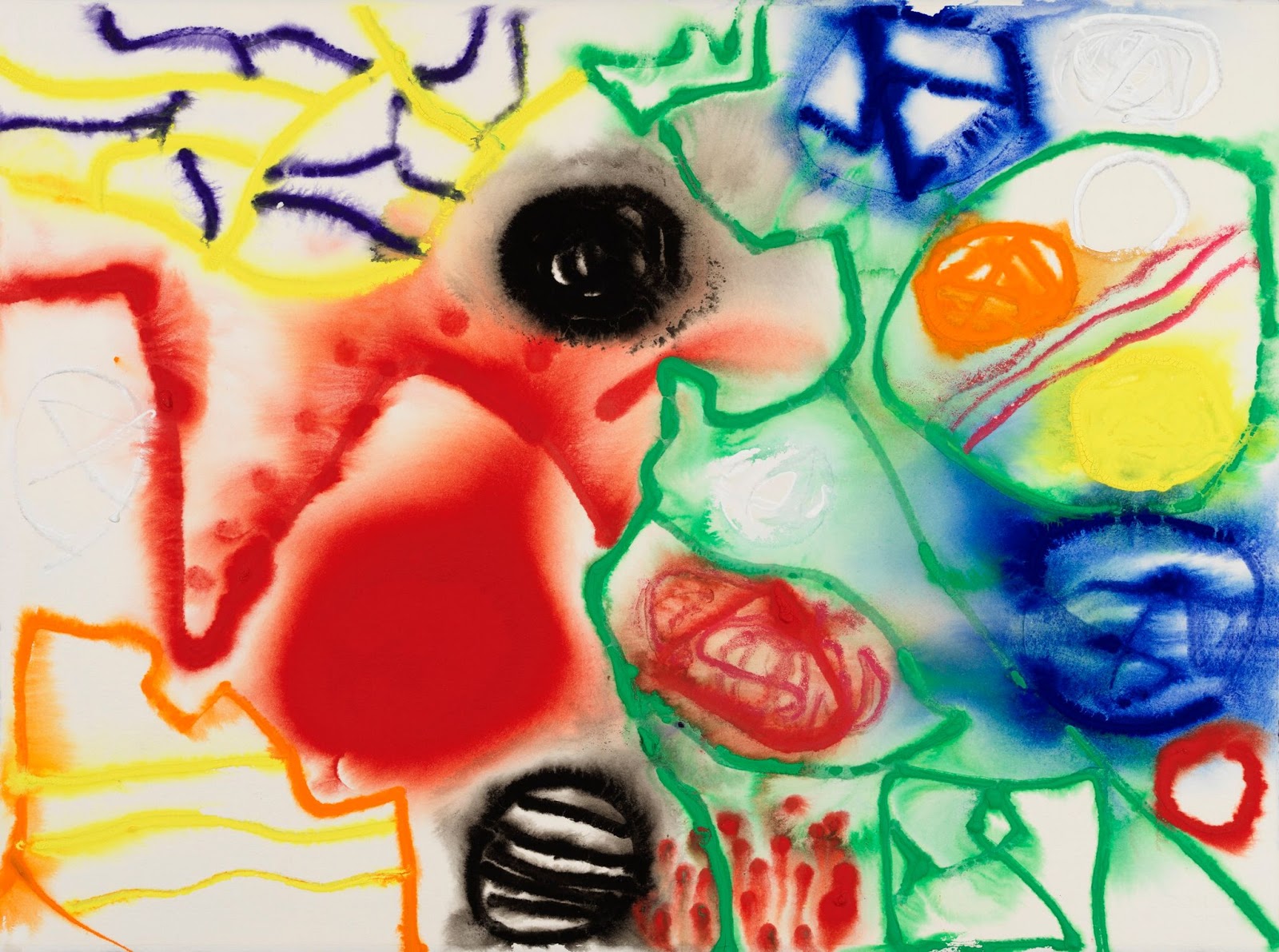
Patrick Heron - Modern British Abstract Art
Patrick Heron (30 January 1920 – 20 March 1999) was a British abstract and figurative artist, critic, writer, and polemicist,who lived in Zennor, Cornwall.Heron was recognised as one of the leading painters of his generation. Influenced by Cézanne, Matisse, Braque and Bonnard, Heron made a significant contribution to the dissemination of modernist ideas of painting through his critical writing and primarily his art.Heron's artworks are most noted for his exploration and use of colour and light. He is known for both his early figurative work and non-figurative works, which over the years looked to explore further the idea of making all areas of the painting of equal importance....Heron used that most rare and uncanny of gifts: the ability to invent an imagery that was unmistakably his own, and yet which connects immediately with the natural world as we perceive it, and transforms our vision of it. Like those of his acknowledged masters, Braque, Matisse and Bonnard, his paintings are at once evocations and celebrations of the visible, discoveries of what he called "the reality of the eye"Wikipedia
Subscribe to:
Posts (Atom)