Exposition Art Blog: and sculptor
Showing posts with label and sculptor. Show all posts

Jean Fautrier - Art Informel


 Jean Fautrier (1898 –1964) was a French painter, illustrator, printmaker, and sculptor. He was one of the most important practitioners of Tachisme.Jean Fautrier was born in Paris in 1898. He was given his unwed mother's surname and raised by his grandmother until she and his father both died in 1908. He then moved to London to be with his mother. There, in 1912, he began to study at the Royal Academy of Arts. Unsatisfied by instruction he thought too rigid, he left to study briefly at the Slade School, which was reputed to be more avant-garde. He was disappointed again and decided to go it alone, devoting himself to painting. The works he saw in the Tate Gallery made a far greater impression on him; he especially admired the paintings of J. M. W. Turner. He was called up for the French Army in 1917, but was discharged in 1921 due to his poor health. He first exhibited his paintings at the Salon d'Automne in 1922 and at the Fabre Gallery in 1923. It was at the Galerie Fabre that he met art dealer Jeanne Castel, his first collector and friend. In 1923 he began producing etchings and engravings. His first solo exhibition was at the Galerie Visconti in Paris, in 1924.
In 1927, he painted a series of pictures (still lifes, nudes, landscapes) in which black dominates. In 1928 he met André Malraux through Castel. Malraux asked Fautrier to illustrate a text of his choice, but copyright issues kept him from using his first choice, Arthur Rimbaud’s ‘’Les Illuminations’’, and he settled instead with Dante’s Inferno. He produced 34 lithographs, but the publication, proposed by Gallimard, was deemed impossible and the project was abandoned in 1930. Until 1933 he divided his efforts between sculpture and painting. Short on funds, he spent the years 1934–1936 living in the resort of Tignes, where he made his living as a ski instructor and started a jazz club.
In 1939, just as World War II was beginning, Fautrier left the mountains, moving to Marseille, Aix-en-Provence, and Bordeaux before finally returning to Paris in 1940 and starting to paint once again. In Paris he met several poets and writers for whom he created illustrations. In January 1943, he was arrested by the German Gestapo. After brief imprisonment, he fled Paris and found refuge in Châtenay-Malabry, where he began work on the project of the Otages (or "Hostages"). These paintings were a response to the torture and execution of French citizens by the Nazis outside his residence, and were exhibited in 1945 with the Drouin gallery. In the years that followed, Fautrier worked on the illustrations of several works, among them L'Alleluiah by Georges Bataille, and made a series of paintings devoted to small familiar objects.
His late work is abstract, generally small in scale, often combining mixed media on paper. In 1960 he won the international grand prize at the Venice Biennale as well as another major award at the Tokyo Biennale the following year. He died in Châtenay-Malabry in 1964, the same year in which he had made donations to the Musée de l’Ile-de-France in Sceaux and Musée d’Art Moderne de la Ville de Paris. A retrospective of his work opened there later that year. and was organized by the Gianadda Foundation at Martigny in January–March 2005.Wikipedia


Alabama - William Christenberry

William Christenberry Jr. (November 5, 1936 – November 28, 2016) was a photographer, painter, and sculptor who worked with personal and somewhat mythical themes growing out of his childhood experiences in Hale County, Alabama
Christenberry received his bachelor's (1958) and master's (1959) degrees in fine arts from the University of Alabama, studying under abstract expressionist Melville Price. Beginning in 1968 he taught at the Corcoran College of Art and Design in Washington, D.C.His artistic career began with the painting of large abstract-expressionist canvasses, but gradually he began to be drawn to material that spoke about the place of his childhood. Although he was raised in Tuscaloosa, Christenberry spent his summers with extended family in rural Hale County. After graduating from the University of Alabama and beginning a promising, if not immediately rewarding, artistic career in New York City, he came across the 1941 book, Let Us Now Praise Famous Men, in which James Agee describes in prose, and Walker Evans in photographs, the experience of living among the dirt-poor farming families of Hale County during the Great Depression. Some of Evans's photographs made a deep impression on Christenberry.


 Shortly after beginning a professorship at Corcoran College, Christenberry began making annual visits to Hale County during the summer to visit family and to explore and make photographs. Originally these all were made with a Kodak Brownie camera given to him as a child, but he later moved to a large format view camera in order to capture more detail. On one occasion in 1973, Walker Evans, who had encouraged Christenberry to take his photographs seriously, accompanied him. This was Evans's first and only return to Hale County since 1936.
One of the results of this pilgrimage was a series of photographs documenting the decay of individual structures, which are photographed as nearly isolated objects. In 1974, Christenberry began translating some of these photographed buildings into detailed sculptures that accurately reproduce their state of decay and patina. Although detailed and properly proportioned, Christenberry did not refer to these creations as models, as he says they are not based on precise measurements, and he preferred that they be called sculptures. The bases for these sculptures often are set in soil taken from these places. On many of these trips, Christenberry collected old advertising signs and other found objects which inspired him. Some of these are incorporated into his work, while others hang in his studio.


 Another series of works was provoked by an incident when, out of curiosity, he tried to attend a meeting of the Ku Klux Klan. Confronted at the door by a glaring masked figure, Christenberry fled. Although he destroyed his first two Klan paintings, the subject occupied him for many years, resulting in a dense multi-media construction adjacent to his studio that came to be known as the "Klan Room," which was burgled mysteriously in 1979. Christenberry largely reconstructed the room, which is filled with paintings, found objects, drawings, sculptures, dioramas, and a series of fabric dolls of Klansmen in their hooded robes.Wikipedia


Art informel Jean Fautrier

Jean Fautrier (May 16, 1898 – July 21, 1964) was a French painter, illustrator, printmaker, and sculptor. He was one of the most important practitioners of Tachisme.Jean Fautrier was born in Paris in 1898. He was given his unwed mother's surname and raised by his grandmother until she and his father both died in 1908. He then moved to London to be with his mother. There, in 1912, he began to study at the Royal Academy of Arts. Unsatisfied by instruction he thought too rigid, he left to study briefly at the Slade School, which was reputed to be more avant-garde. He was disappointed again and decided to go it alone, devoting himself to painting. The works he saw in the Tate Gallery made a far greater impression on him; he especially admired the paintings of J. M. W. Turner. He was called up for the French Army in 1917, but was discharged in 1921 due to his poor health.


 He first exhibited his paintings at the Salon d'Automne in 1922 and at the Fabre Gallery in 1923. It was at the Galerie Fabre that he met art dealer Jeanne Castel, his first collector and friend. In 1923 he began producing etchings and engravings. His first solo exhibition was at the Galerie Visconti in Paris, in 1924.
In 1927, he painted a series of pictures (still lifes, nudes, landscapes) in which black dominates. In 1928 he met André Malraux through Castel. Malraux asked Fautrier to illustrate a text of his choice, but copyright issues kept him from using his first choice, Arthur Rimbaud’s ‘’Les Illuminations’’, and he settled instead with Dante’s Inferno. He produced 34 lithographs, but the publication, proposed by Gallimard, was deemed impossible and the project was abandoned in 1930. Until 1933 he divided his efforts between sculpture and painting. Short on funds, he spent the years 1934–1936 living in the resort of Tignes, where he made his living as a ski instructor and started a jazz club


 In 1939, just as World War II was beginning, Fautrier left the mountains, moving to Marseille, Aix-en-Provence, and Bordeaux before finally returning to Paris in 1940 and starting to paint once again. In Paris he met several poets and writers for whom he created illustrations. In January 1943, he was arrested by the German Gestapo. After brief imprisonment, he fled Paris and found refuge in Châtenay-Malabry, where he began work on the project of the Otages (or "Hostages"). These paintings were a response to the torture and execution of French citizens by the Nazis outside his residence, and were exhibited in 1945 with the Drouin gallery. In the years that followed, Fautrier worked on the illustrations of several works, among them L'Alleluiah by Georges Bataille, and made a series of paintings devoted to small familiar objects.
His late work is abstract, generally small in scale, often combining mixed media on paper. In 1960 he won the international grand prize at the Venice Biennale as well as another major award at the Tokyo Biennale the following year. He died in Châtenay-Malabry in 1964, the same year in which he had made donations to the Musée de l’Ile-de-France in Sceaux and Musée d’Art Moderne de la Ville de Paris. A retrospective of his work opened there later that year. and was organized by the Gianadda Foundation at Martigny in January–March 2005.Wikipedia


Alexander Liberman

Alexander Semeonovitch Liberman (September 4, 1912 – November 19, 1999) was a Russian-American magazine editor, publisher, painter, photographer, and sculptor. He held senior artistic positions during his 32 years at Condé Nast Publications.When his father took a post advising the Soviet government, the family moved to Moscow. Life there became difficult, and his father secured permission from Lenin and the Politburo to take his son to London in 1921.
Young Liberman was educated in Russia, England, and France, where he took up life as a "White Émigré" in Paris.
He began his publishing career in Paris in 1933–36 with the early pictorial magazine Vu, where he worked under Lucien Vogel as art director, then managing editor, working with photographers such as Brassaï, André Kertész, and Robert Capa.
After emigrating to New York in 1941, he began working for Condé Nast Publications, rising to the position of editorial director, which he held from 1962-1994.


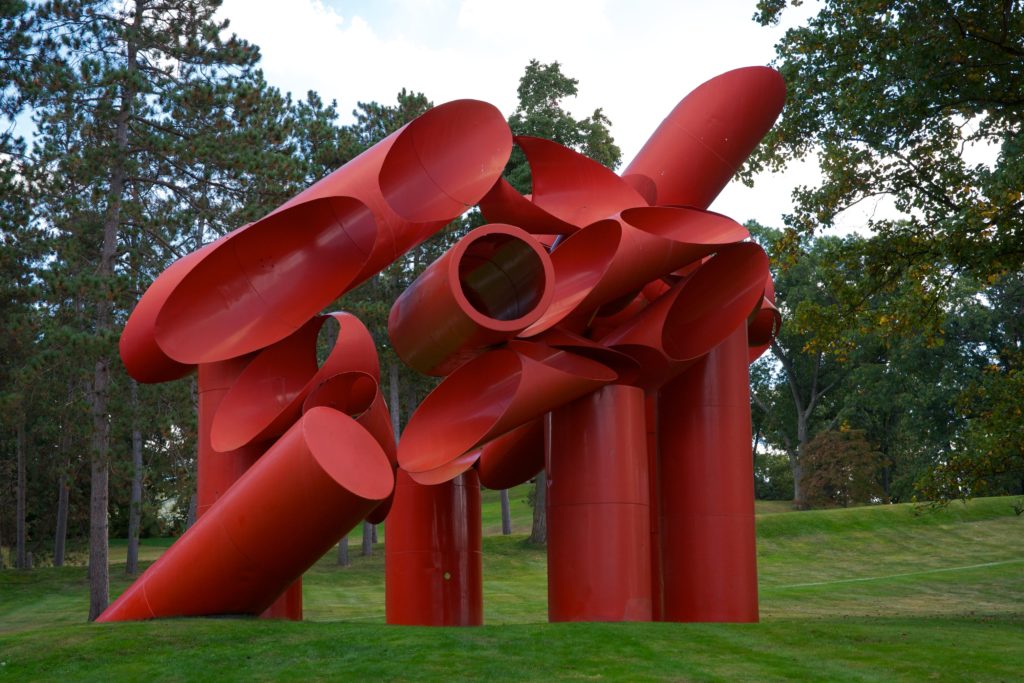
 Only in the 1950s did Liberman take up painting and, later, metal sculpture. His highly recognizable sculptures are assembled from industrial objects (segments of steel I-beams, pipes, drums, and such), often painted in uniform bright colors. In a 1986 interview concerning his formative years as a sculptor and his aesthetic, Liberman said, "I think many works of art are screams, and I identify with screams."Prominent examples of his work are in the collections of the Metropolitan Museum of Art, Storm King Art Center, Hirshhorn Museum and Sculpture Garden, Pyramid Hill Sculpture Park, Tate Gallery, and the Guggenheim Museum. His massive work "The Way", a 65 feet (20 m) x 102 feet (31 m) x 100 feet (30 m) structure is made of eighteen salvaged steel oil tanks, and became a signature piece of Laumeier Sculpture Park,[9] and a major landmark of St. Louis, Missouri.


 He was married briefly to Hildegarde Sturm (August 25, 1936), a model and competitive skier. His second wife (since 1942), Tatiana Yacovleff du Plessix Liberman (1906–1991), had been a childhood playmate and baby sitter. In 1941, they escaped together from occupied France, via Lisbon, to New York. She had operated a hat salon in Paris, then designed hats for Henri Bendel in Manhattan. She continued in millinery at Saks Fifth Avenue where she was billed as "Tatania du Plessix" or "Tatania of Saks", until the mid-1950s. In 1992, he married Melinda Pechangco, a nurse who had cared for Tatiana during an early illness. His stepdaughter, Francine du Plessix Gray, is a noted author.Wikipedia


Naftali Bezem

Naftali Bezem (November 27, 1924) is an Israeli painter, muralist, and sculptor
Bezem was born in Essen, Germany, in 1924. His early adolescence was spent under Nazi oppression, in constant fear for the safety of his parents, who perished in Auschwitz concentration camp. Naftali emigrated to Mandate Palestine in 1939, at the age of fourteen with a Youth Aliyah group.


 From 1943 to 1946, he studied art at the Bezalel Academy of Art and Design in Jerusalem with Israeli painter Mordecai Ardon. He then spent three years studying in Paris.His most famous public works include a wall relief at Yad Vashem in Jerusalem and the ceiling mural in the main reception room at the President's Residence, Jerusalem.Wikipedia


Nathan Oliveira


Nathan Oliveira (December 19, 1928 – November 13, 2010) was an American painter, printmaker, and sculptor, born in Oakland, California to immigrant Portuguese parents. Since the late 1950s Oliveira has been the subject of nearly one hundred solo exhibitions in addition to having been included hundreds of group exhibitions, in important museums and galleries worldwide. He taught studio art for several decades in California beginning in the early 1950s when he taught at the California College of the Arts (formerly California College of Arts and Crafts) in Oakland. Then, after serving as a visiting artist at several universities, he became a Professor of Studio Art at Stanford University.
In 1999 Nathan Oliveira was awarded the Distinguished Degree of "Commander" in "The Order of the Infante D. Henrique," awarded by the President of Portugal and the Portuguese government, for his artistic and cultural achievements.Wikipedia


Art that inspires you