Exposition Art Blog: surrealist paintings
Showing posts with label surrealist paintings. Show all posts

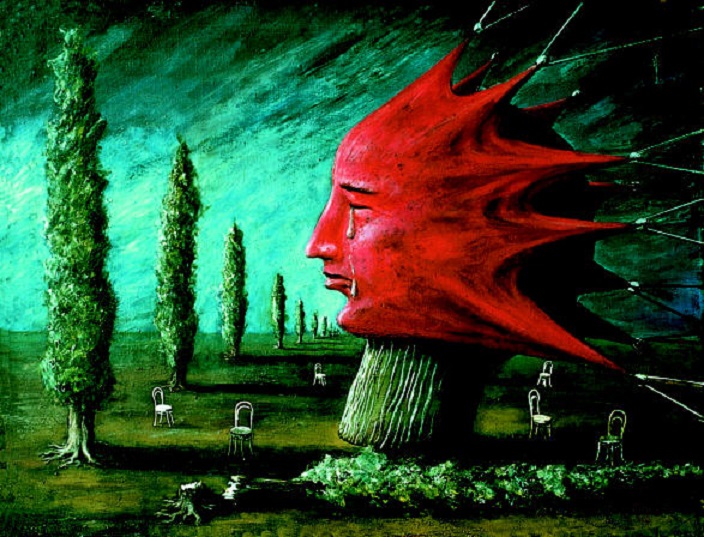
Poul Anker Bech - Surreal Landscapes

Poul Anker Bech (13 April 1942 – 7 October 2009) was a Danish painter.
He started painting in the 1960s and studied at The Jutland Academy of Art in Aarhus, 1966–67. He quit his job in 1988 to become a full-time painter.
Poul Anker Bech painted everyday landscapes and situations, from an unusual point of view. His motives often contain ironic or surrealistic elements.
He himself has said that he would like his paintings to easily be remembered, without needing to understand their meaning.On 27 August 2003 a Danish 19-krone stamp was published using one of Poul Anker Bech's paintings, Det forjættede land (the promised land). He was the recipient of a lifetime stipendium from the Danish government's Art Fund, as well as several prizes.Poul Anker Bech was a member of the Corner artist group. 


A Fine Line Between Surrealism and Expressionism - Clara Ledesma

Clara Ledesma Terrazas (5 March 1924 – 25 May 1999)was an artist from the Dominican Republic.In 1949, Ledesma had her first solo exhibition and in 1951 she opened a studio/gallery, where she displayed her works as well as those of other artists. With the proceeds from a very successful solo exhibition in 1952, Ledesma traveled to Europe to further her education. She studied painting in Barcelona and Madrid, and exhibited her works in galleries in Spain. Ledesma also traveled to Lisbon and Paris to visit important museums. She was particularly influenced by the works of Marc Chagall, Joan Miró and Paul Klee. During her stay in Europe, Ledesma met Bolivian artist Walter Terrazas, who returned to Santo Domingo with her in 1954."She studied painting at prestigious academies abroad and then returned to the country where she presented works that she had conducted in Europe under the influence of Miro, Chagall and Paul Klee, among others.In Santo Domingo, she worked closely with other important Dominican artists, including Gilberto Hernández Ortega, Josep Gausachs and Jaime Colson. In 1955, she was named vice director of the National School of Fine Arts.In 1961, Ledesma and her husband moved to New York City, New York, where she opened another gallery. She lived and worked in New York City the rest of her life.Ledesma had numerous international solo exhibitions, including events in Madrid, Mexico City and New York City, and participated in group exhibitions in Brazil, Spain, Cuba, Haiti, Venezuela, Argentina and Puerto Rico.
Ledesma's style ranged from Expressionism and Surrealism to Abstraction. She is known for her use of brilliant colors, imaginative figures and the feeling of magic and mysticism created in her paintings and drawings. In 1955, journalist Horia Tanasescu described her work, "At times ironic, often playful, but taking great care in the production of her paintings, this artist introduces an enthusiasm for life to the national art scene that is in striking contrast to the solemnity of the majority of her fellow artists.""“Ledesma also touched on social realism in her work, with her most noted series underlining the racial inequities of the time.”"She tried to represent native paintings, with concern, but away from the drama. One of her best stage was marked by the issue of blackness."Wikipedia


Dorothea Tanning

"Dorothea Tanning was born in 1910 in Galesburg, Illinois and attended Knox College in her hometown before studying painting in Chicago (haunting the Art Institute where she learned what painting was.)   In 1941, now in New York, she met the art dealer, Julien Levy, and his surrealist friends, refugees from Nazi occupied France. Late in 1942 Max Ernst visited her studio, saw a painting, (Birthday), and stayed to play chess. They would have 34 years together, at first in Sedona, Arizona (a mere outpost at the time).  Here she would continue to paint her enigmatic versions of life on the inside, looking out: The Guest Room, The Truth About Comets, Eine Kleine Nachtmusik, Interior with Sudden Joy, Insomnias, Palaestra, Tamerlane, Far From. By 1956 Max and Dorothea had chosen to live and work thenceforth in France. Though Paris was headquarters, they preferred the country quiet lure in Touraine and Provence. These years included, for Dorothea Tanning, an intense five- year adventure in soft sculpture:  Cousins, Don Juan's Breakfast, Fetish, Rainy Day Canapé, Tragic Table, Verb, Xmas, Emma, Revelation or the End of the Month, Hôtel du Pavot Room 202.
Max Ernst died on April 1, 1976 and Dorothea faced a solitary future. “Go home,” said the paint tubes, the canvases, the brushes. Returning to the United States in the late 1970s, and still painting, Tango Lives, Woman Artist, On Avalon, Door 84, Still in the Studio, Blue Mom, Dionysos S.O.S., she gave full rein to her long felt compulsion to write.  Words, poetry.  Written, read, heard.  Would she join these voices even then?  Her poems have since appeared in a number of literary reviews and magazines, such as The Yale Review, Poetry, The Paris Review, The New Yorker, The Boston Review, The Southwest Review, Parnassus, and in Best Poems of 2002 and 2005. Her published works include two memoirs, Birthday and Between Lives, a collection of poems, A Table of Content, and a novel, Chasm.....Dorothea Tanning died at her home in New York City on January 31, 2012.  She was 101 years old, and had just published her second collection of poems."(dorotheatanning.org)


 "Now the doors are all open, the air is mother-of-pearl, and you know the way to tame a tiger. It will not elude you today for you have grabbed a brush, you have dipped it almost at random, so high is your rage, into the amalgam of color, formless on a docile palette.
As you drag lines like ropes across one brink of reality after another, annihilating the world you made yesterday and hated today, a new world heaves into sight. Again, the event progresses without the benefit of hours.
The application of color to a support, something to talk about when it’s all over, now holds you in thrall. The act is your accomplice. So are the tools, beakers, bottles, knives, glues, solubles, insolubles, tubes, plasters, cans; there is no end ..."Dorothea Tanning


 "Tanning’s early works – paintings such as Birthday and Eine kleine Nachtmusik (1943, Tate Modern, London) – were precise figurative renderings of dream-like situations. Like other Surrealist painters, she was meticulous in her attention to details and in building up surfaces with carefully muted brushstrokes. Through the late 1940s, she continued to paint depictions of unreal scenes, some of which combined erotic subjects with enigmatic symbols and desolate space. During this period she formed enduring friendships with, among others, Marcel Duchamp, Joseph Cornell, and John Cage; designed sets and costumes for several of George Balanchine's ballets, including The Night Shadow (1945) at the Metropolitan Opera House; and appeared in two of Hans Richter's avant-garde films.
Over the next decade, Tanning's painting evolved, becoming less explicit and more suggestive. Now working in Paris and Huismes, France, she began to move away from Surrealism and develop her own style. During the mid-1950s, her work radically changed and her images became increasingly fragmented and prismatic, exemplified in works such as Insomnias (1957, Moderna Museet, Stockholm). 


 As she explains, "Around 1955 my canvases literally splintered... I broke the mirror, you might say.”By the late 1960s, Tanning’s paintings were almost completely abstract, yet always suggestive of the female form. From 1969 to 1973, Tanning concentrated on a body of three-dimensional work, soft, fabric sculptures, five of which comprise the installation Hôtel du Pavot, Chambre 202 (1970–73) that is now in the permanent collection of the Musée National d'Art Moderne at the Centre Georges Pompidou, Paris. During her time in France in the 1950s-70s, Tanning also became an active printmaker, working in ateliers of Georges Visat and Pierre Chave and collaborating on a number of limited edition artists’ books with such poets as Alain Bosquet, Rene Crevel, Lena Leclerq, and André Pieyre de Mandiargues.After her husband's death in 1976, Tanning remained in France for several years with a renewed concentration on her painting. These years included, for Dorothea Tanning, an intense five- year adventure in soft sculpture. By 1980 she had relocated her home and studio to New York and embarked on an energetic creative period in which she produced paintings, drawings, collages, and prints."Wikipedia 


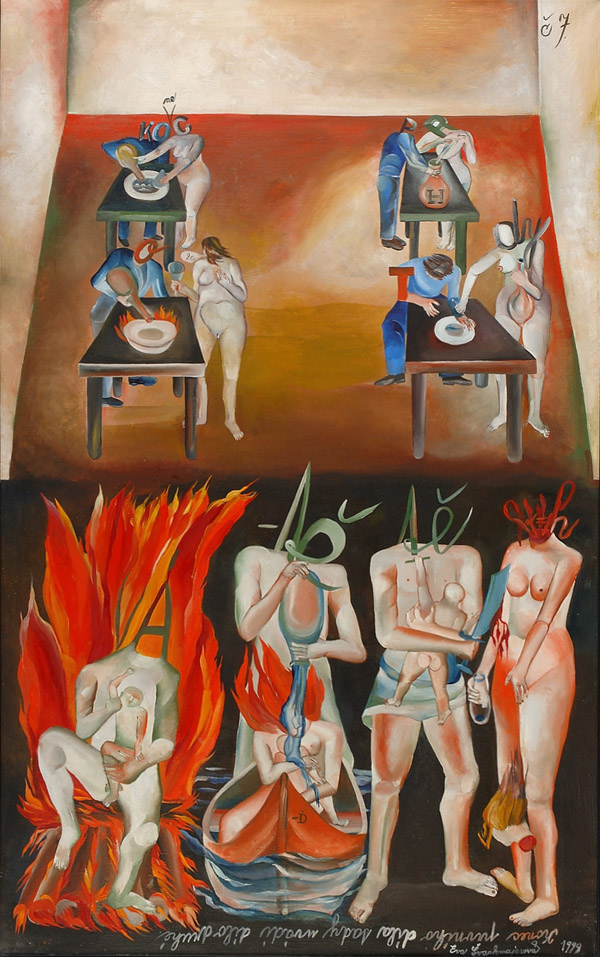
Eva Svankmajerova - Czech surrealist artist

Eva Švankmajerová (September 25, 1940 – October 20, 2005) was a Czech surrealist artist. She was born Eva Dvořáková. A native of the Czech town of Kostelec nad Černými lesy, she moved to Prague in 1958 to study at the Prague School of Interior Design and later the Academy of Performing Arts (Theater Department). From 1970, she was an active member of the Czech and Slovak Surrealist Group. She was a painter and ceramicist, and her poetry and prose regularly appeared in the journal Analogon. Most recently, her work has appeared in English in Surrealist Women: an International Anthology (Austin: University of Texas Press, 1998) and Baradla Cave (Twisted Spoon Press, 2001). Švankmajerová was married to the Surrealist filmmaker Jan Švankmajer, with whom she collaborated on such films as Alice, Faust, and Conspirators of Pleasure. They had two children, Veronika and Václav, and lived in Prague until her death in 2005.


Surrealism - Edgar Ende

Edgar Karl Alfons Ende (23 February 1901 – 27 December 1965) was a German surrealist painter and father of the children's novelist Michael Ende.
Ende attended the Altona School of Arts and Crafts from 1916 to 1920. In 1922 he married Gertrude Strunck, but divorced four years later. He remarried in 1929, the same year his son Michael was born. In the 1930s Ende's Surrealist paintings began to attract considerable critical attention, but were then condemned as degenerate by the Nazi government. Beginning in 1936 the Nazis forbade him to continue to paint or exhibit his work. In 1940 he was conscripted into the Luftwaffe as an operator of anti-aircraft artillery.The majority of his paintings were destroyed by a bomb raid on Munich in 1944, making his surviving pre-war work extremely rare. In 1951, Ende met the recognized founder of Surrealism, André Breton, who admired his work and declared him an official Surrealist. He continued to paint surrealist works until his death in 1965 of a myocardial infarction.
Ende's paintings are thought to have had a significant influence on his son's writing. This is inferred in the scenes depicting the surreal dream-paintings from Yor's Minroud in Die Unendliche Geschichte (The Neverending Story), and is made explicit in Michael Ende's book Der Spiegel im Spiegel (The mirror in the mirror), a collection of short stories based on (and printed alongside) Edgar Ende's surrealist works.Wikipedia