Exposition Art Blog: Abstract Expressionism Artworks
Showing posts with label Abstract Expressionism Artworks. Show all posts

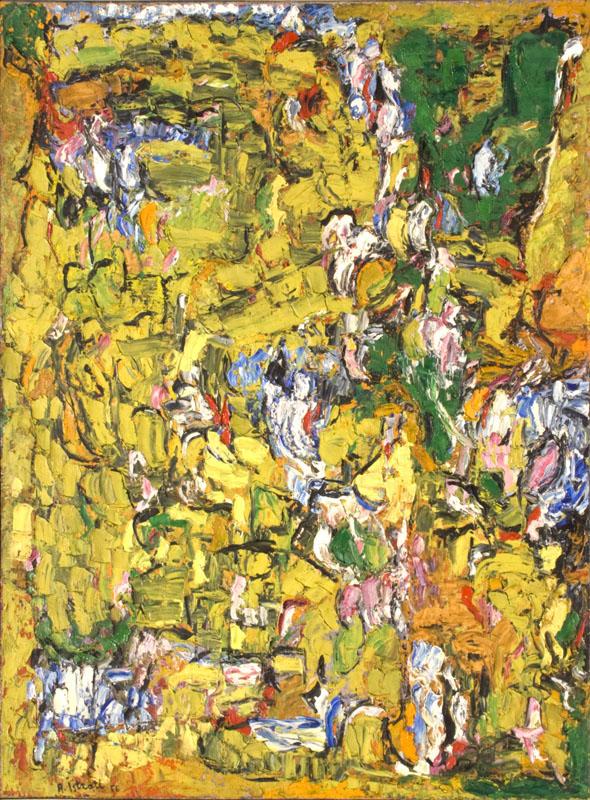
Richard Dick Wray - Abstract Expressionism Artworks


Richard Dick Wray (1933 - 2011) was an American abstract expressionist painter whose work had an influence on the art scene in Houston, Texas. After an art career spanning over 50 years, he died at age 77 of liver disease. His work continues to be showcased by art institutions and organizations across Houston, including the William Reaves Gallery, and is listed on the official website for the National Gallery of Art.
In 1955, Wray received an honorable discharge from the Army and enrolled in the School of Architecture of the University of Houston. There, he would spend the next 3 years studying various forms of architecture, until leaving the school to finish his studies at the Kunstakademie Düsseldorf, the Arts Academy of the city of Düsseldorf, Germany. Wray travelled to Europe in 1958 in order to discover what he believed was the "center" of the art world. The two years he spent in Europe—beginning in Paris and concluding in Germany—laid the foundation for his painting career. Though originally interested in architecture, Wray's interactions with the work of abstract expressionists, artists of a European avant-garde movement known as the CoBrA group and New York Abstract Expressionists (which Wray also saw for the first time in Europe) had tremendous influences on his artistic passions. In effect, Wray deviated away from architecture and, equipped with new knowledge of European expressionism, returned to Texas at age 26 to begin his career as a painter.Wikipedia


Ben Culwell - Abstract Expressionism Artworks


 Ben Culwell  (1918— 1992)
"It is for the important average that I want to speak, the rank and file. The general nature of the use I try to make of the art of painting is, I hope, apparent: that is, to express the sum of relationships which is a total human being. With art, as with atomic physics, the big problem in the world today is to bring the human being abreast of the techniques and the inventions of his material culture—to achieve an adequate modern spiritual integrity."-- Ben Culwell,
A San Antonio native, Culwell was reared in Houston and graduated from high school in Dallas.  After declining a scholarship offered by the Dallas Art Institute, he studied two years at Southern Methodist University, Dallas, and in 1936 Columbia University, where his instructors included Walter Pach.  In 1937 Culwell returned to Dallas and worked for an insurance company.  He began to exhibit his works and taught at the Texas State College for Women, Denton (1940-41)until he enlisted in the U.S. Navy in October 1941.
War with Japan began while Culwell was on a transport bound for Pearl Harbor.  Beginning in January 1942, he served in the Pacific on the heavy cruiser USS Pensacola, primarily as a captain's yeoman, receiving three campaign ribbons and thirteen battle stars.  During the 1942 Battle of Tassafarongo off Guadalcanal, the Pensacola was hit by a torpedo, resulting in an explosion that killed or wounded 1,300 of the crew.  After a year of repairs, the cruiser returned to the South Pacific war with Culwell aboard.  In 1944 he left the Pensacola for reserve midshipman training at Cornell University, from which he was commissioned ensign.  He also attended Colgate University.
After the war, Culwell settled in Dallas and pursued concurrent careers as a painter and successful businessman in insurance.  His business took him to San Antonio in 1950 to open a new office.  He Returned to Dallas in 1954.  In 1961 he moved to Temple, where he became president of American Desk Manufacturing Company, retiring in 1974 to paint full time.  Culwell died in a Marlin hospital and was buried in Temple.